Move More to Hurt Less
"Freddie, you sorted my back out, I'm feeling better — and now you're telling me I need to start lifting weights? I just want to go back to normal."
Freddie: "You ARE going back to normal. Strength training IS normal. The window is open right now — let's walk through it before it closes."
How quickly do we lose fitness without training?
The window is real — and it doesn't stay open forever
We've talked before about how hands-on treatment — whether it's manual therapy, dry needling, mobilisation, or any combination — creates a window of opportunity. Pain settles. The nervous system calms down. Movement feels safer.
But here's the honest truth: that window is temporary. Pain relief is not the same as recovery. If we stop at "feeling better" and don't build anything on top of it, we're just waiting for the problem to come back. And it usually does.
The chart above shows why. The moment we stop loading our body — whether through injury, pain avoidance, or just life getting in the way — we start losing fitness. Power goes first. Strength follows. And unlike bone density (which takes years to shift), the qualities that protect your joints, absorb load, and keep you moving well can disappear in a matter of weeks.
Strength training is how we use the window. It's how we turn temporary relief into lasting change.
But first —
why does everything hurt more when you're out of condition?
This is the part people don't expect.
When we're deconditioned — meaning our muscles are weaker and our nervous system has lost the habit of loading — even normal everyday movements feel like too much. Picking up shopping. Climbing stairs. Getting up from a chair. These tasks suddenly feel harder than they should, and they often hurt more.
There are two reasons for this.
The first is physical: weaker muscles mean more stress on joints, tendons, and bones. The structure has to compensate, and compensation eventually breaks down.
The second is neurological — and this is the one most people haven't heard about.
Your nervous system needs to relearn that movement is safe
Think of your nervous system like a security guard. After an injury or a long period of pain, that guard gets very jumpy. It starts flagging movements as "dangerous" even when the tissue has healed. The result is guarding — muscles bracing, range of motion shrinking, and pain turning up earlier and louder than it should.
This is why some people still hurt long after their injury has healed. The tissue is fine. But the nervous system hasn't got the memo.
Strength training changes this. Here's how:
When you repeatedly load a movement — even lightly, in a controlled way — your nervous system starts to collect evidence. Each successful rep is data: "I did that. It was okay. I'm still intact." Over time, the guard relaxes. The threat response quietens. Movement starts to feel normal again.
This process has a name: graded motor relearning. But really it's just your brain updating its map of what your body can safely do.
Here's what happens step by step:
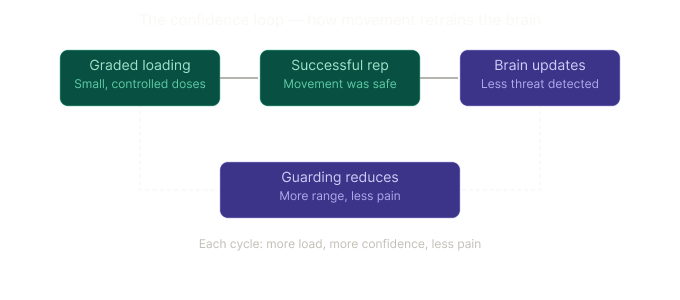
This cycle is the reason strength training reduces pain — not just by making muscles stronger, but by changing the story your brain tells about movement. Every completed session is another data point telling your nervous system: "This body is capable. This is safe. We can do more."
What strength training actually does for pain and function
Here's the plain-language version of the evidence:
Muscles act as shock absorbers. Stronger muscles take load off joints, tendons, and discs. Less joint stress, less pain over time.
Proprioception improves. This is your body's ability to sense where it is in space. After injury, this sense gets blurry. Loading it back up sharpens it — and better proprioception means fewer stumbles, fewer re-injuries, and movements that feel more controlled and confident.
Tendons get tougher. Tendons respond slowly to training — but they do respond. Specifically loaded exercise is one of the only ways to meaningfully strengthen tendon tissue. This is gold for anyone dealing with chronic tendon problems.
Endorphins and natural pain modulators are released. Exercise is one of the most powerful pain-reducing interventions that exists, and it's free.
Bone density is maintained or improved. Load is the single best signal you can give bone to stay dense. This matters enormously as we age.
Sleep improves. Better sleep = lower pain sensitivity. This one compounds quickly.
The three phases — where you are in recovery changes what we do
Not all training looks the same. The dose matters enormously. This is why we don't hand everyone the same program.
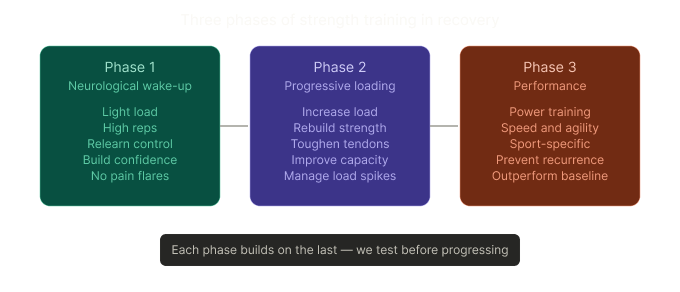
Phase 1 is not about getting fit. It's about reintroducing the nervous system to loading, letting it collect evidence that movement is safe, and building the foundation for everything that follows. The weights are light. The reps are comfortable. The wins are small but they compound.
Phase 2 is where the real tissue adaptation happens. Muscles get bigger. Tendons get tougher. Bone gets denser. The body becomes more robust — harder to injure, faster to recover.
Phase 3 is where we get you back to what you actually want to do: run trails, climb routes, compete, keep up with your grandkids, or just carry groceries without a second thought.
At The Movement Co, we test at each transition. We don't progress you because time has passed — we progress you because the data says you're ready.
A note on "but exercise makes my pain worse"
This is one of the most common things we hear. And it makes complete sense — if every time you've tried to be active your pain has spiked, your brain has learned a very clear lesson: movement equals danger. So it cranks up the alarm to stop you.
The answer is not to push through blindly. That's not bravery — that's just more data confirming the threat. The answer is precision: finding the right dose of the right movement, at the right time, and building from there. Pain during exercise is not automatically a red flag. Pain that persists for more than an hour after exercise, or that gets progressively worse across sessions, is information worth acting on.
We track this. We adjust. We work with your nervous system, not against it.
"So basically, movement is actually medicine."
Freddie: "The most underrated medicine going. And no prescription required."
