What If Treating Your Pain Also Changed Your Life?
OsteoMAP (Osteopathy, Mindfulness and Acceptance Programme): Just not the GPS kind but a way to find your way back to living a fuller life despite pain.
"Freddie, I've heard you mention something called OsteoMAP. That sounds like an app that gives you directions."
Freddie: "In a way — it kind of does. Just not the GPS kind. It helps people find their way back to living a fuller life despite pain. Which, for a lot of people with chronic pain, feels like they've been lost for years."
The problem with just treating the body
We've written before about how pain is a brain output — shaped not just by tissue, but by fear, beliefs, stress, sleep, and a person's whole lived experience. And yet most pain treatment still focuses almost entirely on the physical: mobilise the joint, release the muscle, reduce the inflammation.
For acute pain — a fresh sprain, a post-surgical knee, a new disc injury — that's often enough. The tissue heals, the pain resolves, life goes on.
But for people living with persistent pain — pain lasting more than three months, pain that doesn't follow the usual tissue healing timelines, pain that has started to organise their entire life around it — hands-on treatment alone is rarely sufficient. Research consistently shows this. The COPERS trial (Taylor et al, 2016), one of the largest studies of its kind, demonstrated that psychological self-management approaches produce meaningful improvements in anxiety, depression, self-efficacy, and social integration that physical therapy alone does not.
So the question becomes: what does an integrated approach — one that combines the best of osteopathic hands-on care with evidence-based psychological tools — actually look like in practice?
That question is what OsteoMAP was built to answer.
What is OsteoMAP?
OsteoMAP stands for Osteopathy, Mindfulness and Acceptance Programme. It was developed by Dr Hilary Abbey at the University College of Osteopathy (UCO), formerly the British School of Osteopathy — the same institution where Freddie completed his Master of Osteopathy training.
It's a six-session, individually tailored programme that weaves together three things:
Osteopathic hands-on treatment, delivered in the usual way — mobilisation, soft tissue work, movement therapy
Mindfulness — not as relaxation, but as a skill: learning to notice what's happening in your body right now, without immediately reacting to it
Acceptance and Commitment Therapy (ACT) — a third-wave cognitive behavioural approach that helps people develop a more flexible relationship with pain, and reconnect with what matters most in their lives
The programme was funded by the UK Department of Health and formally evaluated across 256 patients and 80 osteopaths. Results published by Abbey, Nanke and Brownhill (2020) showed significant improvements in quality of life, coping, psychological flexibility and mindfulness. 95% of patients were satisfied and reported meaningful changes at six months.
Who is OsteoMAP for?
OsteoMAP is designed for people whose pain has become persistent — where the original injury or episode has long since passed its expected healing window, and yet pain remains, shapes daily decisions, and limits life.
Conditions where OsteoMAP is particularly well-suited include:
Chronic low back pain — the most studied application; research by Draper-Rodi, Vogel and Bishop (2018) identified 55 modifiable biopsychosocial factors in non-specific low back pain, many of which OsteoMAP directly addresses
Fibromyalgia and widespread pain syndromes
Chronic neck pain and headache disorders
Persistent joint pain from osteoarthritis
Post-surgical pain that outlasts recovery timelines
Pain associated with hypermobility syndromes (hEDS/HSD)
Chronic fatigue and pain overlap conditions
Pain that has become entangled with anxiety, low mood, or trauma
"Medically unexplained" pain — where nothing shows on scans but the suffering is very real
The common thread is not a diagnosis — it's a pattern. People who are caught in what OsteoMAP calls the "futile struggle to get rid of pain," whose lives have narrowed around avoiding discomfort, and who have lost sight of what they actually value.
Now here's how the six sessions are structured, and what each one is doing.
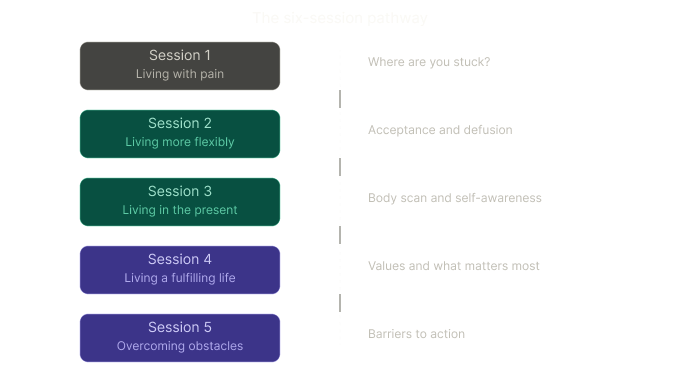
Session 6 — Moving Forward — draws everything together into a personal self-management plan. It's about leaving with skills, not dependency.
What makes it different from regular osteopathy?
The key shift is in therapeutic stance. In standard osteopathy, the practitioner's job is to find the problem and fix it. In OsteoMAP, the aim is different: the practitioner and patient work together, with the patient as the expert in their own life. The osteopath's job is to create a space where the person can notice their automatic reactions to pain — the tensing, the bracing, the avoidance — and gently explore whether there are other ways to respond.
Hands-on treatment continues throughout. But it's used differently — as a vehicle for mindful awareness, not just symptom relief. When pain arises during treatment, rather than immediately moving away from it, the patient is invited to stay with it for a moment. To get curious. To notice what it actually feels like, separate from the fear of what it might mean.
This is built on Lorimer Moseley's work on pain neuroscience — the idea that helping people understand and approach their pain, rather than flee from it, directly recalibrates the nervous system's threat response.
The goal is not to get rid of pain. It's to help people live fully despite it — and in doing so, the pain often quietens on its own.
"So the aim is to stop fighting the pain and start living around it?"
Freddie: "More than around it. Through it, and toward what matters. That's the OsteoMAP difference."
OsteoMAP at The Movement Co
We offer OsteoMAP as a structured six-session programme, with each session running approximately one hour. It integrates directly with our broader approach — osteopathic care, pain education, and rehabilitation — making it a natural fit for patients who have been managing persistent pain and are ready to take back control.
It's particularly valuable for patients who have already tried multiple treatments without lasting relief, who notice that stress and anxiety amplify their pain, or who feel that pain has shrunk their world in ways that go beyond the physical.
If you're curious about whether OsteoMAP is right for you, the first step is a pre-course conversation — no commitment, just a conversation about where you are and where you'd like to be.
We've also created a short downloadable taster session — a simple 20-minute self-guided OsteoMAP introduction you can try before booking.
Download it here.
Get started to take hold of your pain with an appointment or contact Freddie for a pre-course chat for more info.
