TRUST Your Heart
— Gold-Standard Cardiovascular Health Tests You Can Do at Home
"Freddie, I don't have a cardiologist. I don't have a fancy heart rate monitor. How do I actually know if my heart is doing okay?"
Freddie: "Your heart tells you more than you'd think — if you know what to listen for. And most of it costs nothing but two fingers and a watch."
Why cardiovascular fitness matters more than almost anything else
The research on this is unambiguous. In 2002, Jonathan Myers and colleagues published a landmark study in the New England Journal of Medicine showing that exercise capacity — measured as VO2max — is the single strongest predictor of all-cause mortality. Stronger than blood pressure. Stronger than smoking. Stronger than body weight.
Cole et al. (NEJM, 1999) showed that heart rate recovery after exercise — how quickly your heart slows down — independently predicts cardiac death, even after adjusting for other risk factors.
You don't need a lab. Here are four validated at-home tests that give you a meaningful picture of your cardiovascular health right now.
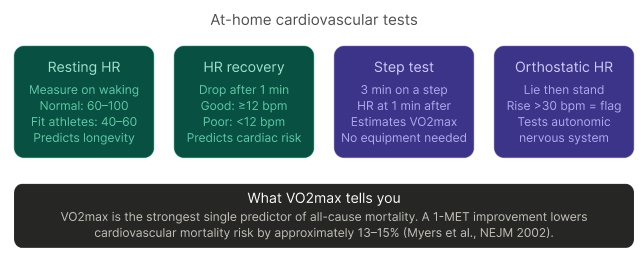
American Heart Association / AHA 2022 guidelines. Cole et al., NEJM 1999.
-
The simplest and most informative daily check you can do.
How to do it: Before getting out of bed in the morning, place two fingers on the inside of your wrist (radial pulse) or the side of your neck (carotid pulse). Count beats for 60 seconds, or count for 30 seconds and multiply by 2.
What it means:
60–100 bpm: normal adult range
Below 60 bpm: common in aerobically fit individuals
Above 80 bpm at rest: associated with increased cardiovascular risk even within "normal" range (Jouven et al., European Heart Journal, 2005)
Trending upward day to day: a consistent rise of 5–7 bpm above your baseline is a reliable signal of illness, overtraining, or stress
Track it weekly. The trend matters more than a single reading.
-
This one requires a little effort but is remarkably well validated.
How to do it: Exercise vigorously for 3 minutes — brisk stair climbing, jumping jacks, skipping — hard enough that you're breathing heavily. The moment you stop, note your heart rate. Wait exactly 60 seconds, then take your heart rate again. Subtract the second from the first.
What it means:
Drop of ≥12 bpm: normal
Drop of ≥22 bpm: excellent autonomic function
Drop of <12 bpm: associated with significantly increased all-cause mortality (Cole et al., NEJM 1999)
A sluggish recovery means your parasympathetic nervous system (the "rest and digest" branch) is not switching on efficiently after stress. This is a clinically meaningful finding that deserves attention, not just a gym metric.
-
The YMCA 3-minute step test has been used in clinical and research settings for decades. It estimates VO2max — your maximal oxygen uptake — from your heart rate response to a standardised submaximal bout of exercise.
How to do it:
Find a step 30cm high (a stair works perfectly)
Step up and down at a steady pace: up-up-down-down, 24 steps per minute (roughly one step every 2.5 seconds — use a metronome app)
Continue for exactly 3 minutes
Sit down immediately and take your pulse for the full 60 seconds after stopping
Then use the VO2max norm table above to find your fitness category by age and sex. A higher VO2max for your age bracket is directly associated with lower risk of cardiovascular disease, dementia, type 2 diabetes, and all-cause mortality.
Reference norms: American College of Sports Medicine (ACSM) VO2max normative data tables.
-
This simple test assesses autonomic nervous system function — how well your body handles the shift from lying to standing. It's particularly relevant for people with dizziness on standing, fatigue, or those with suspected POTS (Postural Orthostatic Tachycardia Syndrome).
How to do it:
Lie flat and rest for 5 minutes. Take your heart rate.
Stand up slowly. Take your heart rate at 1 minute of standing.
Calculate the difference.
What it means:
A rise of 10–20 bpm: normal physiological response
A rise of >28–30 bpm: meets criteria for POTS (Sheldon et al., Heart Rhythm, 2015)
Symptoms of dizziness, palpitations, or blurred vision on standing alongside a rise >30 bpm warrants GP referral
What to do with your results
A below-average VO2max, slow heart rate recovery, or positive orthostatic response are not diagnoses — they are signals. They tell you where to direct your energy.
At The Movement Co, cardiovascular fitness is something we build into your rehabilitation and performance programs from the start — not as an afterthought. The window of opportunity after treatment is the ideal time to begin graded aerobic conditioning. The evidence for its benefit is stronger than almost any other single intervention.
References:
Myers J et al., NEJM 2002; Cole CR et al., NEJM 1999;
Jouven X et al., Eur Heart J 2005;
Sheldon RS et al., Heart Rhythm 2015;
ACSM Guidelines for Exercise Testing and Prescription, 11th Ed.
