Shockwave Therapy - or some mythical dragonball z finishing move?
"Freddie, I heard about shockwave therapy for my Achilles. Is it the thing they use on hearts?"
Freddie: "Different machine, different purpose — but you're not the first person to ask. Let me explain what it actually does, what it's genuinely good for, and when it's probably not the right call."
Part 1 — What is shockwave therapy?
Radial shockwave therapy uses a handheld device to deliver rapid pulses of pressure into soft tissue
— tendons, muscles, and their attachments to bone. Think of it like a very precise, very fast tapping into the deeper layers of tissue.
It is not electrical stimulation. It is not ultrasound. It is not a laser.
It is a mechanical pressure wave — and the way it works is different from most other physiotherapy tools.
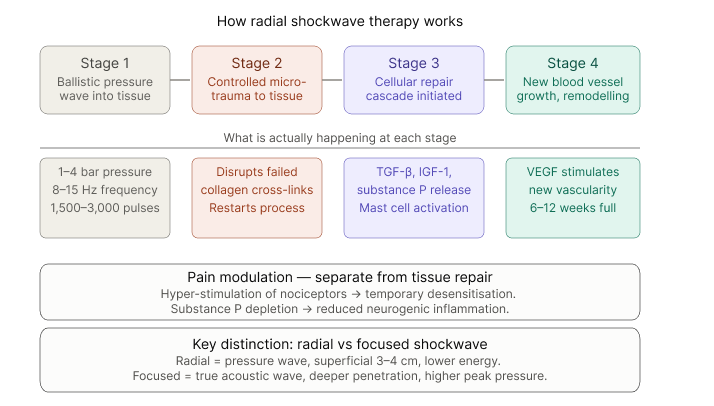
The device we use at The Movement Co is a radial shockwave device — meaning the pressure wave spreads outward from the tip.
It reaches 3–4 centimetres into tissue, which is the right depth for most tendon and soft tissue conditions. There are also deeper, higher-energy "focused" shockwave devices used in hospitals for things like kidney stones — that is a different machine for different purposes.
If you feel like you want to geek out like myself on the science behind it, below is a simplified infographic for further elaboration:
Part 2 — Why would you deliberately hit sore tissue?
This is the question most patients ask, and it is the right one.
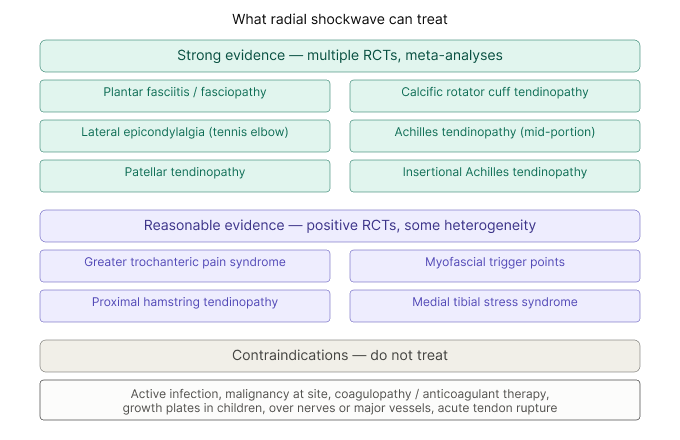
Shockwave works best for a specific problem: tissue that has stopped healing. The most common example is a chronically painful tendon — the Achilles, the plantar fascia on the bottom of the foot, the patellar tendon below the kneecap, or the rotator cuff in the shoulder.
In these long-standing problems, the tendon has tried to heal — sometimes repeatedly — and failed. Instead of healthy, organised tissue, what is left is a disorganised tangle of inferior collagen with poor blood supply. It hurts, it is weak, and it has essentially stalled.
The problem is: there is nothing left to restart the repair process.
Shockwave creates a small, controlled disruption in that stalled tissue. Think of it like clearing a blocked drain. The disruption triggers the body's repair machinery — growth factors, new blood vessel formation, fresh collagen production — to have another go. It is not fixing the tissue directly. It is giving your body a reason to try again.
At the same time, shockwave temporarily desensitises the nerve endings in the area, which is why many patients notice some pain relief quickly. That early pain relief is neurological — not structural. The actual tissue repair takes 6–12 weeks. This distinction matters, and we will come back to it.
Now here is what it can treat, and how well.
Shockwave vs hands-on treatment: what is actually different?
Most manual therapy — massage, joint mobilisation, dry needling — works primarily through your nervous system. The treatment settles pain signals, relaxes guarded muscles, and helps you move more freely. These effects are real and often immediate. But for a tendon that has genuinely broken down and stopped healing, settling the pain signal does not fix the structural problem. The tendon is still disorganised. It will keep hurting.
Shockwave is different because there is reasonable evidence it actually changes the tissue — stimulating new blood supply, encouraging fresh collagen growth, and breaking down calcium deposits. That is not something most other manual therapy tools can claim with the same confidence.
The honest comparison:
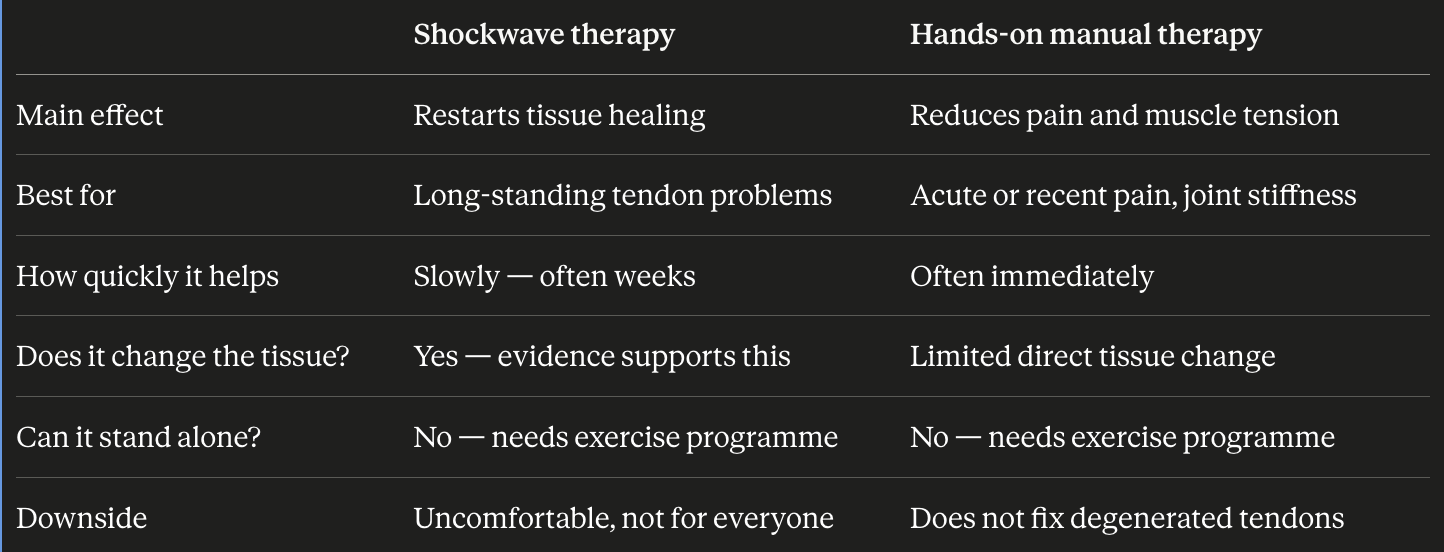
The bottom rows matters: neither works well alone. Shockwave without a loading programme produces weaker, slower results.
The research is clear on this — the mechanical stimulus of gradually re-loading the tendon is what organises the new tissue that shockwave initiates. One without the other is half a treatment.
What to expect as a patient
It is uncomfortable. Most people describe a deep aching pressure, sometimes sharp at the treatment site. This is expected and is part of how it works. If it does not feel like anything, the settings are probably too low or the probe is not in the right place.
You will likely feel worse before you feel better. Soreness for 24–48 hours after treatment — especially after the first couple of sessions — is normal. Use ice if needed. Do not take anti-inflammatory medication in that window — it blunts the very response the treatment is trying to trigger.
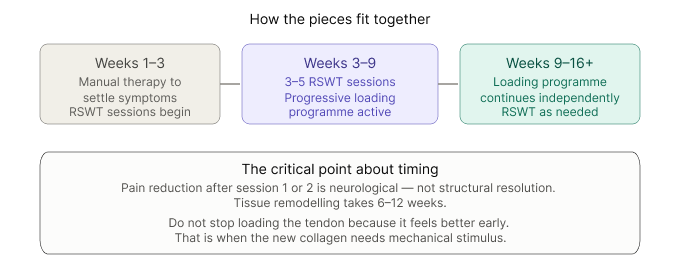
The timeline is not fast. A typical course is 3–5 sessions, one week apart. Some conditions take longer. The early pain relief you might notice after session one or two is coming from your nervous system settling down — not from the tendon healing. The actual tissue change takes 6–12 weeks. Keep doing your exercises even when it starts feeling better. Especially then.
It does not work for everyone. For the best-studied conditions, roughly 60–80% of patients get meaningful improvement. That is a good result — but it means a real proportion of people do not respond. If three or four sessions produce nothing, more sessions are unlikely to change that. We reassess rather than continue.
"So: uncomfortable, takes time, and you still have to do the exercises."
Freddie: "Yes to all three. Anyone selling it as a quick painless fix is overpromising."
How it fits into the bigger picture
Shockwave is a tool, not a treatment plan. At The Movement Co it is always part of a broader programme — assessment first, manual therapy where needed to settle acute symptoms, shockwave to restart tissue repair, and a structured loading programme to build the tendon back to full strength.
The integration looks like this:
Shockwave therapy is available at The Movement Co as part of an integrated treatment plan.
Book at the-movement-co.com — Initial consult (45-min) for a thorough assessment before Shockwave can be prescribed as the recommended approach. | $115 NZD. ACC subsidies available for related injuries.
