An Osteo, Physio and CHiro walked into a bar…
Kind of rare that might happen, but somewhere in the progressive societal alternative universe, this will happen.
Now, what's the actual differences or similarities between them?
"Freddie, I've been to the other two. A physio and a chiro, and now you. My back still hurts. Was I wasting my time with the other two?"
Freddie: "Not necessarily. But it's worth understanding that you weren't shopping for the same product each time — even if the treatment table looked identical."
The question people are actually asking
When someone chooses a physio over a chiro, or an osteo over a physio, they're often choosing based on things that have nothing to do with the core clinical difference between the professions. They choose based on what a friend recommended. Or what their GP suggested. Or which one has a car park. Or which one they associate with a specific technique — "I want needling" or "I want the cracking" or "I want exercises."
None of those are the right question.
The right question is:
what clinical system does this practitioner operate within,
what is their framework for understanding what is wrong with me,
and what does a good outcome look like in their model?
Those three questions have genuinely different answers across the three professions.
And understanding the difference helps you make a better decision — not just about which profession to see, but about what you need right now.
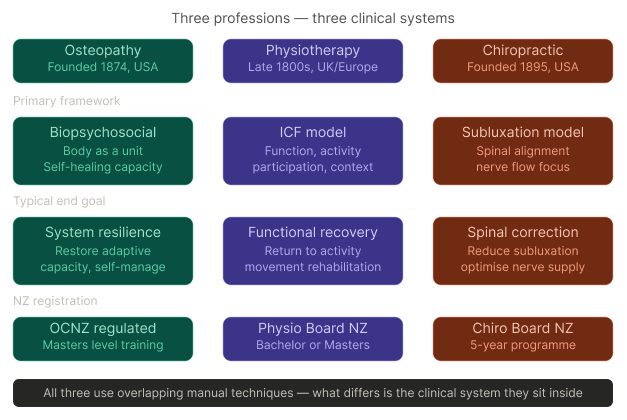
Three professions, three frameworks
The diagram above maps the three dimensions. Here is the plain narratives behind them.
Physiotherapy grew out of medicine and wartime rehabilitation. If you broke your knee in the Somme and needed to walk again, a physiotherapist was the person who helped you do it. That origin shapes the profession today. Physios think in terms of function — what can you do, what can't you do, and what do we need to build to close that gap? They are the practitioners most integrated with hospitals, surgeons, and sports medicine teams. Their training has a strong rehabilitation and exercise prescription component, and their approach is closely aligned with the medical system. The goal is recovery.
Chiropractic was founded in 1895 around the idea that the spine is central to health, and that misalignments — called subluxations — interfere with the nervous system and the body's ability to heal. Contemporary chiropractors vary enormously in how much of this original philosophy they carry forward. Many have moved substantially toward mainstream pain science and evidence-based practice, and in those cases their day-to-day work can look very similar to physiotherapy or osteopathy. The traditional model still shapes chiropractic culture, though — with an emphasis on spinal correction, regular maintenance visits, and the spine-health relationship.
Osteopathy was founded in 1874 around a different idea: that the body is an interconnected system with a built-in capacity to regulate and heal itself, and that the clinician's job is to remove whatever is getting in the way of that. This is why osteopaths take long histories, ask about sleep, stress, digestion, and general health alongside the aching back or shoulder. It is not nosiness. It is a clinical model that genuinely considers the whole person — not just the part that hurts. The osteopathic approach has always been closer to what medicine now calls biopsychosocial care than most other manual therapy traditions.
All three professions are fully regulated in New Zealand. All three require formal tertiary training. All three can help with musculoskeletal pain.
The difference is not in the techniques — it is in the thinking.
The techniques are similar. The systems are not.
This is the part that confuses most people.
A physio, a chiro, and an osteo can all perform spinal manipulation, soft tissue massage, dry needling, exercise prescription, and joint mobilisation. If you watched three sessions on video with the practitioner's face blurred, you might not be able to tell the difference. The techniques overlap substantially.
What differs is the clinical reasoning that selects the technique, the framework that interprets the response, and the definition of what a successful outcome looks like.
A physiotherapist mobilising your lumbar spine is primarily asking: how does this serve the patient's return to function? Are we reducing movement impairment? Are we building exercise tolerance?
A chiropractor adjusting your lumbar spine may be asking: are we correcting segmental dysfunction and restoring normal biomechanics? Is this segment contributing to the broader pattern?
An osteopath performing the same manipulation is asking: how does this segment relate to the system? What is the compensatory pattern that brought us here, and how does restoring mobility here redistribute load across the whole?
Same technique. Different question. Different interpretation of the result.
This is not a subtle distinction — it changes what gets treated, in what order, for how long, and what the practitioner considers a success.
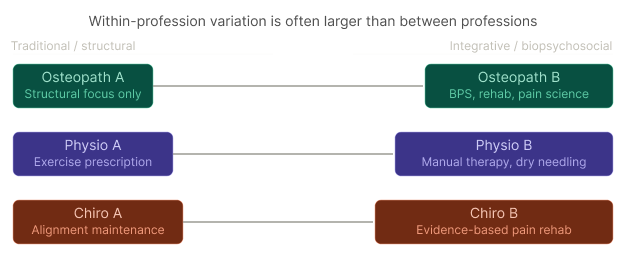
Now here is the part that the "physio vs osteo vs chiro" conversation almost never addresses: the variation within each profession is enormous.
Why you might choose one over another
— and why it isn't about the technique
People often describe their preference in terms of what the practitioner does to them: "I go for the exercises." "I go for the adjustments." "I like the holistic approach." But that is a bit like choosing a restaurant because you like plates. The plate is just the delivery mechanism. What matters is the kitchen.
Here is a more useful way to think about it.
Physiotherapy tends to be the choice when the goal is clearly defined and and back to function: recovering from surgery, hitting specific movement milestones within a timeline. Physios are well set up for structured, staged rehabilitation with targets. Their integration with the medical system also makes them the natural choice when your care needs to be coordinated across a hospital team.
Chiropractic tends to suit people whose complaints are primarily spinal and who respond well to regular hands-on treatment in a maintenance model. For straightforward recurring back or neck pain with no complexity, the evidence for chiropractic manipulation is reasonable and many people find it genuinely useful as part of an ongoing private self-management strategy.
Osteopathy tends to be the best fit when the picture is more complex — when pain has been going on for a while, when it doesn't neatly fit a structural explanation, when previous treatments have helped temporarily but not resolved things, or when life stress, sleep, or other factors seem to be part of the problem. The osteopathic framework is built for that kind of presentation.
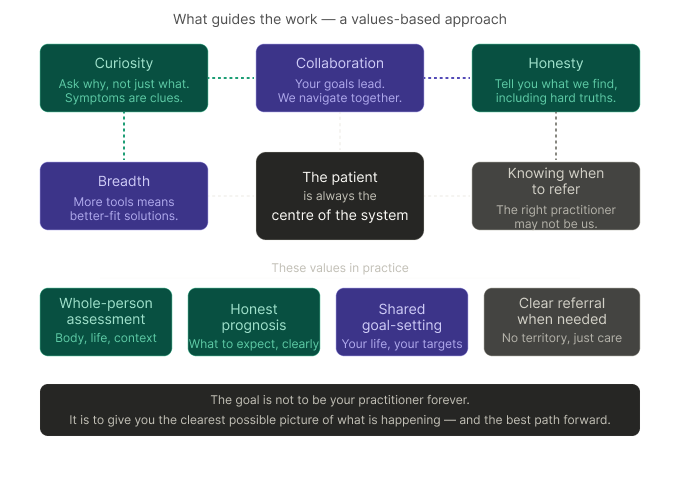
But the most important caveat: these are generalisations about professions, not about the practitioner in front of you.
And the practitioner matters more than the title.
The practitioner matters more than the title
There is genuine variation within every profession — sometimes more variation within a profession than between professions. An osteopath who works primarily in structural technique and sees mostly acute back pain presentations is doing something quite different from an osteopath who works in persistent pain, integrates rehabilitation, and holds additional training in pain science. Both are osteopaths. The experiences are not interchangeable.
At The Movement Co, it is worth being transparent about where Freddie's training sits — not as a sales pitch, but because it genuinely shapes what kind of patients and problems the clinic is best placed to help.
The base training was in the UK, at the University College of Osteopathy in London — one of the oldest osteopathic institutions in the world, with a research and clinical curriculum that sits firmly within evidence-based healthcare. UK osteopathic training has historically been more integrated with pain science and biopsychosocial medicine than the New Zealand training pathway, which has more traditionally emphasised structural and cranial osteopathic approaches. Neither is better. They produce different clinical identities.
What UK training specifically means for patients at The Movement Co is that the assessment framework leans heavily on clinical reasoning, neurological and vascular screening, and a biopsychosocial model of pain — rather than a primarily structural or technique-first approach.
On top of that base, additional training in strength and conditioning means that when rehabilitation is needed, it is properly programmed — progressively loaded, tracked with objective data, and built around the same principles that govern how elite athletes are conditioned. Not "here are three exercises." An actual plan.
Training in OsteoMAP and pain neuroscience means that persistent pain is approached with tools specifically designed for it — not just more manual therapy in the hope that something eventually changes.
Training in medical acupuncture, functional ageing, and working professionally in mountain environments across climbing, alpine guiding, and outdoor education adds clinical perspective that is genuinely difficult to acquire any other way. Knowing how bodies behave under sustained load, in cold and altitude, in multi-day endurance contexts — that is not a course you can take. It is experience.
The reason all of this matters is simple: different problems need different tools, and different clinical lenses see different things in the same patient. Understanding what a practitioner has in their toolkit — and whether that toolkit suits your problem — is a better question than asking which profession they belong to.
"So the short version is: the letters after the name are a starting point, not the whole answer. I should be asking 'does this practitioner's clinical system fit my problem?'"
Freddie: "Exactly. The letters tell you they're qualified. The conversation tells you whether they're right for you. And the honest answer is that sometimes the right answer is 'go and see a physio.' Or your GP. Or a rheumatologist. Knowing when to refer is as important as knowing how to treat."
A practical guide
If you are unsure which to see, these are the questions worth asking:
Does your complaint have a clear structural or surgical component with defined functional targets? — physiotherapy is well-suited.
Is your complaint primarily spinal, mechanical, and recurring? — any of the three may help. Ask about the practitioner's clinical model and approach to chronic presentations.
Is your complaint complex, multi-system, persistent, or not responding to previous treatment? — the osteopathic framework is designed for this. But ask specifically about the practitioner's training in pain science and biopsychosocial care.
Do you have a sports performance or alpine objective that your rehabilitation needs to serve? — look for a practitioner with genuine strength and conditioning training, not just familiarity with it.
Are you an older adult concerned about falls, functional decline, or maintaining independence? — look for objective assessment capability (force plates, dynamometry) not just a conversation about balance exercises.
The title on the door is a start. The conversation in the room is what matters.
