Building a Mountain Athlete
"Freddie, I've been doing a bit of bush walking. My mate does alpine climbing. He says I should train differently. I thought walking was just... walking?"
Freddie: "Walking is a great start. But alpinism — combining technical climbing with mountain approaches, exposed ridgelines, heavy packs, and big vertical days — asks a lot more of your body than most people prepare for. The good news is that the science is very clear on how to train for it."
What alpinism actually demands of your body
Alpinism sits at the intersection of two sports that are already individually demanding: technical rock or mixed climbing, and mountain walking or trekking at altitude. Combined, they ask for:
A very large aerobic engine — you need to sustain effort for 6–14 hours in a day, often at altitude where oxygen is reduced
Muscular endurance in the legs, back, and shoulders — to carry a pack, move efficiently uphill, and handle technical terrain for hours
Strength and power in the upper body and core — for pulling, pressing, and maintaining body tension on technical sections
Sport-specific movement skills — crampon technique, rope work, rock climbing efficiency, route reading
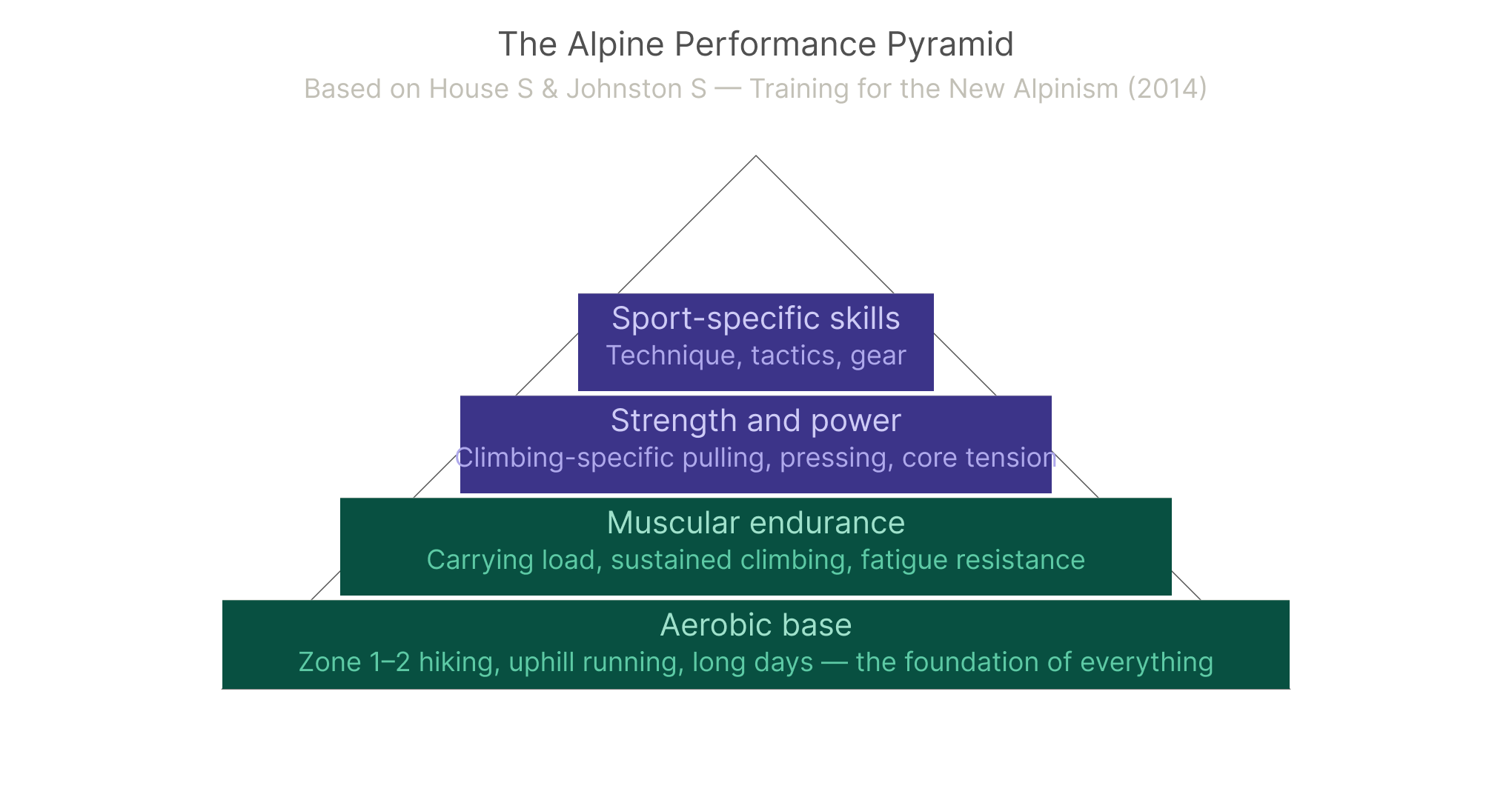
The critical insight from Steve House and Scott Johnston's Training for the New Alpinism (2014) — the definitive training manual for this sport — is that these qualities must be built in a specific order. The pyramid above is their framework. You cannot rush the base. Building strength on top of a weak aerobic system creates a fast-fatiguing, injury-prone athlete. The aerobic base is the multiplier for everything above it.
The physical profiling system
Before training, we need to know where you actually are. At The Movement Co, we use a structured performance profiling toolkit
— developed for competitive and mountain climbers — to assess four distinct domains.
The interactive profile above shows a real example from our assessment system. Each domain has clinical sub-tests, each scored and benchmarked against Long-Term Athlete Development (LTAD) tiers: Learning to Train, Training to Train, and Training to Perform.
The four domains — and why each matters for alpinism:
Athletic Functions: these tests measure the fundamental movement qualities that determine how efficiently you can position your body on a wall or on steep terrain. Poor hip range limits high stepping. Poor shoulder mobility limits overhead reach and pack carrying. Tightness in the posterior chain means your climbing posture collapses under load.
Core Synergistic: the core in climbing is not a six-pack. It is the ability to resist unwanted movement — to keep your feet on the wall when they want to swing off, to hold body tension when you're bridging across an overhang, to transfer force from your feet through your torso to your hands. Weak core function wastes energy and increases injury risk to the shoulder and lower back.
Base Climbing Functions: these test the engine room — the push-pull strength balance and shoulder stability under load that determines how long you can sustain effort on technical terrain before form breaks down.
Advanced Climbing Functions: the highest-specificity domain. Finger strength and single-arm capacity are the primary limiters in intermediate-to-advanced climbing. But they also translate directly to alpinism — gripping axes, maintaining contact strength on cold rock, and managing fatigue across a long technical day.
What the profile reveals is a training priority. Most mountain athletes are reasonably competent at athletic function and aerobic capacity — they walk a lot — but have significant gaps in core function and climbing-specific strength. That gap is precisely where performance and injury risk collide.
How we structure the training year
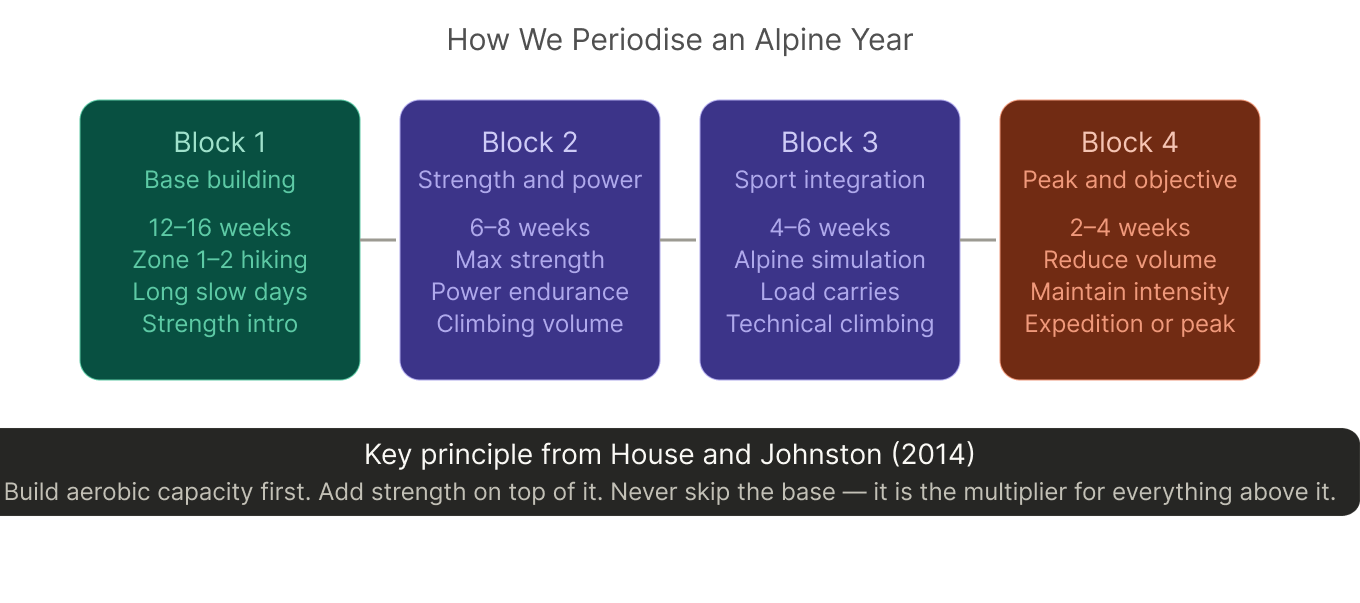
House and Johnston's periodisation model divides the training year into sequential blocks, each building on the last. The diagram above shows the structure we follow at The Movement Co when working with mountain athletes.
The key principles:
Build the base first — and spend more time there than feels comfortable. Most recreational alpinists jump to strength training too early because it feels productive. But without a large aerobic base, strength gains are limited and the risk of overtraining is high. House and Johnston recommend spending 12–16 weeks doing primarily Zone 1–2 aerobic work — hiking with weight, long easy runs, uphill cycling — before adding meaningful strength load.
Zone 1–2 means you can hold a conversation. If you are breathing too hard to talk, you are training above the zone that builds the aerobic engine. The instinct is to push harder. The science says the engine is built at lower intensities than most people assume.
Strength comes second — but it is genuinely important. Once the aerobic base is solid, a 6–8 week strength and power block introduces maximum-effort climbing, fingerboard work, weighted pulling and pressing, and power endurance circuits. This is where the profiling toolkit drives training: the gaps identified in your profile determine exactly where we direct the strength work.
Integration and simulation come third — sport-specific training that combines everything: long days in the hills with technical sections, simulated expedition loads, altitude exposure where possible. This is where the fitness built in the earlier blocks gets tested in conditions that mirror the objective.
Finally, a short peak block reduces volume, maintains intensity, and prepares the body for the actual objective.
The Performance profile in practice
The radar chart in the profile widget above shows what a real assessment looks like. In this example, athletic function is the strongest domain — solid foundational mobility and movement quality. Core function is developing. Climbing-specific strength in the pull and push domain is early-stage. Finger strength and single-arm capacity are just beginning.
This profile tells us exactly where to start:
Priority 1: address the shoulder and posterior chain restrictions flagging in athletic function tests (lat tightness, overhead mobility) — these will limit progress in all domains above
Priority 2: build core function through hollow body progressions, front lever work, and anti-rotation training — this is the multiplier for climbing-specific strength
Priority 3: introduce climbing-specific pulling and shoulder stability work in a structured, progressively loaded program
Priority 4: finger loading protocols on a fingerboard, beginning with assisted dead hangs and building toward body-weight work over 3–6 months
This is not a generic climbing programme. It is built from your data, tracked at every session, and adjusted as you adapt.
Come and get your profile done
Whether you are preparing for your first alpine route in the Southern Alps, building toward a Himalayan objective, or simply want to move better in the mountains than you did last season — the place to start is knowing exactly where you are.
The Movement Co alpine physical profiling assessment covers all four domains, produces a full written report with training priorities, and gives you a clear, evidence-based starting point. We integrate the House and Johnston periodisation framework with your profile to build a training system that is specific to your objective, your timeline, and your current capacity.
"So it's not just going for more walks."
Freddie: "More walks is a good start. A structured program built around your profile is how you actually get to the summit."
