High Frequency Vibration Therapy — the Gentle One That Still Works
"Freddie, everyone I know has one of those percussion massage guns.
And my physio friend mentioned something called vibration therapy. Are they the same thing?"Freddie: "That question is exactly why I want to write this post. The short answer is no.
The longer answer is that confusing the two might be why your shoulder and hips are still sore six months later."
What is high frequency vibration therapy?
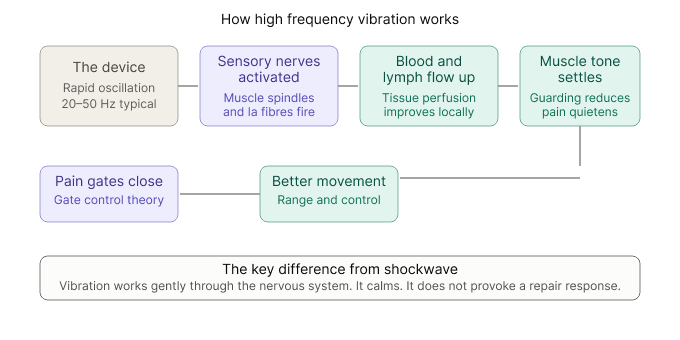
High frequency vibration therapy (HFVT) uses a clinical device that oscillates — vibrates back and forth — at a precise, consistent frequency against the skin and underlying tissue. Clinical devices typically run between 20 and 50 Hz. Some specialised devices go higher for specific applications.
The vibration travels into the tissue beneath. Not just the skin — into the muscle and the fascia surrounding it.
And when it gets there, it sets off a chain of events in the nervous system that produces real, measurable clinical effects.
It is not painful. Most people find it somewhere between neutral and genuinely pleasant. There is no soreness afterwards. There is no tissue disruption. This is the first and most important thing to understand about it — because it tells you exactly what it is doing, and what it is not doing.
Vibration therapy is a calming tool. It works with the nervous system. It settles things down. That makes it fundamentally different from shockwave therapy, which is a deliberate provocation — it intentionally disrupts tissue to restart a stalled repair process. Both are useful. Neither is better. They are just doing different things.
What it is actually doing
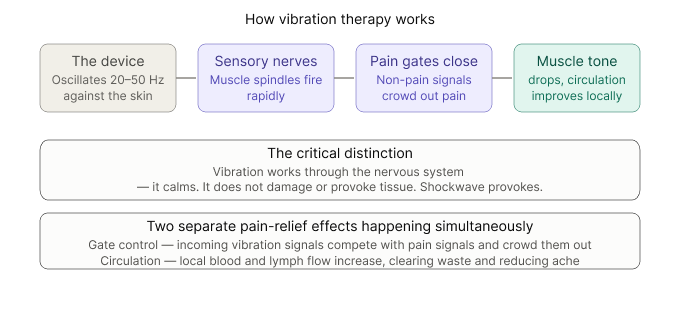
The diagram above shows the four stages. Here is the plain-language version.
When a vibrating device is applied to tissue, it stimulates small sensory receptors called muscle spindles — sensors embedded inside the muscle that detect movement and changes in length. When these fire rapidly, they send a large volume of signals to the spinal cord. Those signals compete with pain signals for the same neural pathways.
The brain can only process so much incoming information at once. When non-painful signals flood in — which is what vibration does — pain signals get crowded out. This is called gate control theory, and it is the same reason rubbing a bruise immediately makes it feel better. It is not imagined. It is basic neuroscience, and vibration therapy exploits it deliberately.
At the same time, the mechanical oscillation of the tissue gently pumps blood and lymph through the area. Local circulation increases. Waste products from tired or overworked muscles clear faster. Fresh oxygen arrives. Tight, aching muscle tissue begins to release its tension — not because it has been forced to, but because the nervous system has been given enough calming input to let it go.
The result: less pain, less tension, better range of motion, and often a noticeably looser feeling in the treated area within minutes.
What it does not do: repair a degenerated tendon. Change the structural quality of tissue. Restart a stalled healing process.
That is shockwave's job, not vibration's.
What can it treat?
The evidence base for vibration therapy is smaller than for shockwave — fewer large randomised controlled trials, more mechanistic research and physiotherapy practice evidence. That does not make it less clinically useful. It means the research is still building, and what we have is enough to use it with good rationale.
Where it works well:
Muscle tension and guarding— the strongest application. Vibration reliably reduces resting muscle tone. For people whose pain is driven by tightness, overworked muscles, and poor local circulation rather than structural tendon degeneration, vibration is often more appropriate than shockwave and far more comfortable.
Post-exercise recovery — established in sports science. Vibration after heavy training reduces delayed onset muscle soreness, accelerates clearance of metabolic waste, and helps restore range of motion. Used at The Movement Co within rehabilitation programmes to help patients tolerate progressive loading.
Sensitive or irritable presentations — when tissue is too reactive to tolerate pressure, friction, or direct loading, vibration offers a way in. It provides sensory input and pain relief without adding load to an already unhappy structure.
Scar tissue and fascial restriction — restricted, adherent tissue responds to oscillation. The mechanical input helps mobilise layers that have become “stuck”, particularly useful in post-surgical recovery or after long periods of immobilisation.
Proprioception and balance — vibration has a longer research history in neurological rehabilitation (stroke, Parkinson's, multiple sclerosis) than in standard musculoskeletal care. In a musculoskeletal context, the improvement in the body's sense of its own position is particularly relevant after ankle sprains, knee injuries, and in older adults where balance is declining.
Preparing tissue for other treatment — used before shockwave to improve local circulation and reduce muscle guarding, making the subsequent treatment more tolerable and potentially more effective.
What to expect
A vibration therapy session is comfortable. The device is applied to the target area for a few minutes — sometimes as preparation before manual therapy or shockwave, sometimes as a standalone component when the presentation calls for it.
There is no soreness afterwards. There is nothing to do during treatment except relax — which, conveniently, is also the therapeutic mechanism.
Effects are relatively immediate but also relatively short-lived unless supported by a rehabilitation programme.
Vibration calms the nervous system and reduces tension. It does not change the underlying tissue.
If the underlying problem is structural — a degenerated tendon, calcium deposits, failed collagen
— vibration will make it feel better temporarily without resolving it.
This is not a criticism. It is simply what the tool is for. Knowing which tool to reach for, and when, is the clinical skill.
Now here is where we put the three devices side by side — including the one that belongs in your gym bag rather than the clinic.
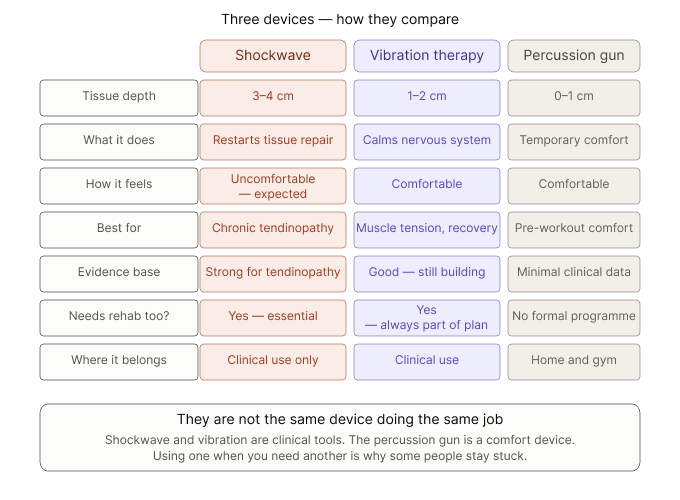
The honest verdict on percussion massage guns
"Freddie, I need to know the truth about my Theragun. I spent two hundred dollars on it."
Freddie: "It is not useless. It just belongs in a different category
— and knowing which category stops you from expecting things from it that it cannot deliver."
A percussion massage gun drives a small attachment head into the body at high speed, repeatedly. It is a percussive tapping device.
The depth it reaches is approximately 0 to 1 centimetre — meaning it compresses the skin and the very top layer of muscle. That is it.
It does not reach deeper muscle belly. It does not reach tendon. It does not reach joint structures.
The clinical vibration device oscillates. The percussion gun taps. These are physically different actions that produce different effects at different depths. The marketing on percussion guns has borrowed the language of clinical vibration therapy — words like "percussive therapy," "deep tissue," "muscle recovery" — but the physics do not support the depth claims.
What a percussion gun actually does: increase superficial blood flow temporarily.
Provide some compression that can feel like it loosens tight skin and the outermost muscle layer.
Deliver a mild sensory stimulus that may briefly crowd out pain through gate control, just as rubbing a bruise does.
It feels good. The feeling is real. The mechanism is superficial.
What it does not do: reach the tissue that is responsible for most musculoskeletal pain presentations. A percussion gun on a chronically sore Achilles tendon does not reach the tendon. A percussion gun on a painful rotator cuff does not reach the rotator cuff. The structure that is causing the problem is simply not where the device is working.
This is not a reason to throw it away. It is a comfort tool for pre-workout preparation, for feeling looser after sitting at a desk, for reducing the sensation of post-exercise soreness in the skin and outermost muscle. These are legitimate uses. It is a reasonable thing to own.
It is not a reason to skip clinical assessment. It is not a substitute for shockwave when a tendon needs structural help. It is not equivalent to clinical vibration therapy when the nervous system needs proper calming. And using a percussion gun on a genuinely inflamed or irritable structure can make things worse — not because the device is powerful enough to cause significant damage, but because repetitive tapping on an already unhappy area adds load that the tissue does not want.
The analogy that makes this clear:
a percussion gun is to clinical vibration therapy what a takeaway coffee is to an intravenous drip.
Both involve liquid. The similarity ends there.
Both vibration therapy and radial shockwave therapy are available at The Movement Co as part of an integrated treatment plan.
Book at the-movement-co.com — Initial consult 45 min | $115 NZD. ACC subsidies available for related injuries.
References:
Rittweger J (2010). Vibration as an exercise modality. Sports Med.
Pamukoff DN et al. (2016). J Sport Rehabil.
Rehn B et al. (2007). Scand J Med Sci Sports — systematic review of vibration effects. Cochrane review on whole-body vibration for musculoskeletal pain (2015).
Binder A & Hazleman B (1983). Lancet — vibration and pain gate. Cochrane review on exercise for shoulder disorders (2016).
