Myofascial Cupping — Ancient Tool, Modern Questions
"Freddie, I keep seeing those perfect circular bruises on athletes.
My friend had it done for back pain. Her practitioner said it was clearing toxins from her blood. Is that... real?"
Freddie: "The treatment is real. The toxin story is not.
But the parts that are real are actually quite interesting — let's start there."
What cupping actually is and the three types
Cupping therapy applies a vessel to the skin and creates negative pressure — suction — that draws the skin and superficial tissue upward into the cup. That is the mechanical action. Everything else — the effects, the explanations, the clinical rationale — follows from that.
Three types are in common use.

Glass cups are the traditional form. In fire cupping, a flame briefly heats the air inside the cup before it is placed on the skin, creating suction as the air cools and contracts. Glass cups are reusable and produce good suction, but require skill and flame management. They are the cups most associated with traditional Chinese medicine and hijama (the Islamic wet cupping tradition).
Plastic cups with a hand pump are the most common clinical version. A valve on top allows the practitioner to create and control suction precisely — specific negative pressure can be applied and held consistently. More controllable, less practitioner skill required, no fire. These are what you will find in most modern physiotherapy and sports medicine cupping contexts.
Silicone cups are squeezed to create suction and then released onto the skin. They are soft, flexible, and the most commonly used for self-application and sliding cupping (where the cup is moved across the skin rather than held static). Lower maximum suction than glass or pump cups, but the flexibility allows them to be used on contoured areas and moved dynamically.
The clinical choice between them is mostly about what you are trying to achieve. Static cupping — placing a cup and leaving it — suits different goals than dynamic or sliding cupping, where the cup is moved across tissue to create a dragging, lifting effect across a broader area.
What is actually happening in the tissue?
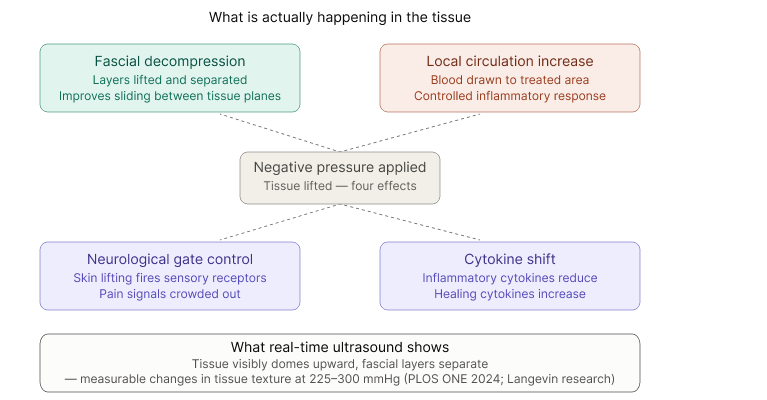
When a cup creates suction, it lifts skin, subcutaneous fat, and superficial fascial layers upward, away from the underlying muscle. The tissue inside the cup is under tensile stress — being pulled. The tissue under the cup rim is under compressive stress. Both forces simultaneously act on the same area.
Research using ultrasound imaging — including work published in PLOS ONE (2024) from the University of Illinois — has confirmed measurable changes in superficial muscle tissue texture after cupping, with effects varying depending on the pressure applied and how long the cup is held. At therapeutic pressures of around minus 225 to minus 300 mmHg, the superficial layer of the muscle shows detectable changes in tissue homogeneity. The tissue becomes less uniform — which researchers interpret as a loosening of the compressed, adhered layers that restrict sliding between structures.
US physiologist Helene Langevin has documented cell-level changes using ultrasound, showing that techniques including cupping reduce markers of inflammation — specifically reducing inflammatory cytokines while increasing cytokines that promote healing and relaxation. Medbridge
There are several proposed mechanisms that likely all contribute to varying degrees:
Fascial decompression — the upward lift separates layers of connective tissue that may have become adherent or compressed. Cupping creates negative pressure that helps lift and separate the fascial layers, enhancing fascial glide — the smooth sliding of structures relative to each other — which is essential for normal movement. This is why sliding cupping, where the cup is moved along the tissue, is particularly suited to myofascial work. The cup effectively acts as a mobile decompressor, lifting and dragging the fascia rather than pressing it down.
Local circulation increase — the suction draws blood toward the treated area. The cupping process draws blood from your vessels into the tissue, starting a positive inflammatory response. This is not a pathological response — controlled micro-inflammation, as we discussed in the shockwave post, is one of the ways the body initiates repair. The local hyperaemia (increased blood flow) that cupping produces persists for some time after the cup is removed.
Neurological gate control — the sensory input of lifting and stretching skin and superficial tissue competes with pain signals. This is the same gate control mechanism we discussed with vibration therapy. The sudden change in tissue position and pressure creates a large burst of proprioceptive and mechanoreceptive input that can temporarily reduce the perception of pain.
Dry cupping therapy alone has been shown to improve pain, range of motion, and functional capacity in patients with myofascial trigger points in the trapezius. The evidence here is reasonable, though not as strong as for shockwave in tendinopathy.
The traditional explanations vs what we actually know
This is the part that requires some honest conversation.
Traditional Chinese medicine cupping theory describes the movement of qi — life force — through meridian pathways, and explains the dark marks left on skin as stagnant or toxic blood being drawn to the surface. Hijama, the Islamic cupping tradition, similarly describes the removal of harmful substances from the blood, often combined with wet cupping (making small incisions in the skin before applying the cup to draw blood).
These frameworks are thousands of years old. They predate microscopy, germ theory, and modern biochemistry. The practitioners who developed them were making their best observations with the tools they had. The explanations they generated — qi, meridians, stagnant blood — were coherent within their cosmological context.
From a modern evidence standpoint, the qi and toxin explanations are not supported. There is no evidence that cupping removes toxins from the bloodstream. The kidneys and liver do that. Blood drawn to the surface by cupping is not "stagnant" in any pathological sense — it is simply blood that has been mechanically attracted to an area of reduced pressure. The dark discolouration that appears on the skin is not evidence of something being drawn out. It is evidence of capillary damage beneath the skin surface.
That last point is worth exploring in some detail, because it is where the misunderstanding is most consequential.
The marks: what they actually are, and what they tell you
This is the most important thing to understand about cupping, and it is the thing that is most frequently misrepresented.
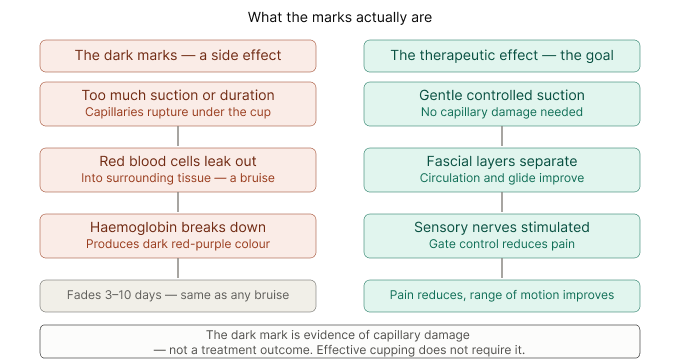
The circular dark marks left after cupping are not evidence of toxins being removed from the blood. They are bruises. Specifically, they are petechiae or ecchymosis — small blood vessels (capillaries) that have ruptured under the negative pressure of the cup, leaking red blood cells into the surrounding tissue. The dark red to purple colour comes from haemoglobin breaking down as the leaked blood is absorbed by the body. They fade over 3 to 10 days, exactly as a bruise does, because they are a bruise.
The intensity of the mark correlates with the amount of suction pressure applied, how long the cup is held, and the fragility of the local capillaries. A person who is on blood thinners, who has thin skin, or who has cups applied with high pressure for a long duration will mark more severely. A person treated with gentle suction for a short time may show little or no marking at all.
Here is the clinically important part: the therapeutic effects of cupping — fascial decompression, improved circulation, pain gate stimulation — do not require capillary rupture. The marks are a side effect of excessive suction, not a sign that treatment has worked.
The belief that darker marks indicate more stagnant blood, more toxins, or a greater need for treatment is not supported by evidence. It is a folk interpretation of a visual phenomenon that has a straightforward mechanical explanation. A good cupping practitioner applies enough suction to lift tissue without producing significant marking. The red ring that sometimes appears immediately around the cup rim after removal is expected — this is reactive hyperaemia, a normal vascular response to suction. It fades within minutes. That is fine. Dark bruising that lasts a week is avoidable, and should be.
There is also a real-time imaging angle on this. Ultrasound research — including the PLOS ONE 2024 study using texture analysis of ultrasound images — demonstrates that tissue changes after cupping occur in the superficial layers whether or not visible marking is present. The tissue response is not contingent on hurting the capillaries. Searching "cupping ultrasound fascia tissue" on YouTube also turns up several clinical demonstrations from physiotherapy researchers showing real-time tissue displacement under the cup — the tissue visibly domes upward, fascial layers separate, and the change is immediately visible on screen. This is the mechanism at work. No bruising required.
What the evidence actually supports
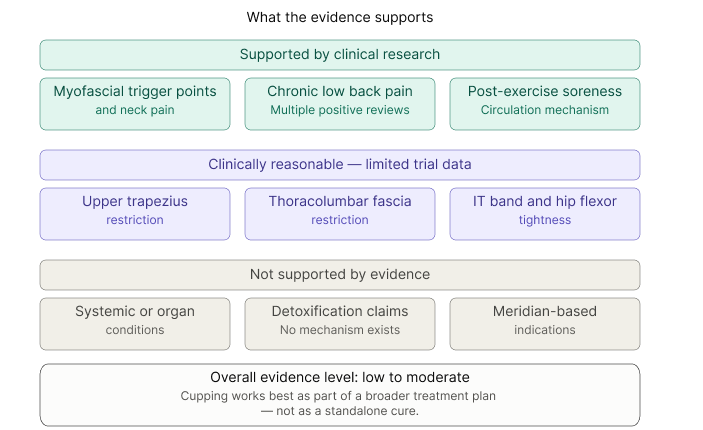
The evidence base for cupping is, to be honest, modest in quality — a lot of small trials, variable methodology, and a general absence of the kind of large, well-controlled studies that exist for shockwave therapy in tendinopathy. The systematic reviews that have been done generally find low to moderate evidence for benefit in specific conditions, with the best evidence for:
Myofascial trigger points and neck pain — the ScienceDirect study published in 2025 found dry cupping alone improves pain, range of motion, and functional capacity in patients with trapezius myofascial trigger points. This is a well-designed comparative study and the results are clinically meaningful.
Chronic low back pain — multiple reviews find positive outcomes, though study quality is variable. The consensus is that cupping produces real pain reduction for low back pain, though the mechanism and optimal dosage remain unclear.
Post-exercise muscle soreness — reasonable evidence that cupping reduces delayed onset muscle soreness, consistent with the circulation-improvement mechanism.
Conditions where evidence is weak or absent: cupping for internal organ conditions, systemic diseases, or the various TCM indications that extend beyond the musculoskeletal system are not well-supported in the scientific literature.
The honest position is: cupping appears to be a legitimate tool for myofascial pain, restricted fascia, and muscle recovery — with a mechanism that makes physiological sense — but it is not the powerful detoxifying intervention that some of its traditional proponents claim. The evidence is enough to use it with good rationale. It is not enough to claim certainty about exactly how or why it works.
How we use cupping at The Movement Co
Myofascial cupping at The Movement Co is integrated into the broader treatment plan — it is not a standalone therapy, and it is not used as a first-line treatment for everything that walks through the door.
The clinical rationale for using it:
When fascial restriction is a primary contributor to restricted movement
— particularly in the thoracic spine, upper trapezius, lats, or hip flexors, where layers of connective tissue have become compressed or adherent.
When trigger points in large muscle groups are contributing to referred pain patterns and have not responded adequately to manual pressure alone. Cupping creates a sustained decompressive lift that is mechanically different from direct pressure, and sometimes reaches tissue that manual therapy does not.
When a patient is too sensitive or irritable to tolerate direct pressure techniques
— the upward lift of cupping is often better tolerated than pressing in.
As part of a sliding cupping sequence along the thoracolumbar fascia, or erector spinae — using the cup as a mobile decompressor to systematically work through a broad fascial sheet.
What we do not use it for: claims about removing toxins, clearing meridians, or treating systemic conditions.
Those are not within the evidence base or within our clinical scope.
The goal of cupping in this context is to create a window — the same window we discussed in the shockwave and vibration posts. Reduce restriction, improve movement, and then build on it with rehabilitation. The cup opens a door. The rehabilitation programme builds the room on the other side.
"So the marks are just bruises, the toxin story is not real, but the treatment itself has a legitimate use."
Freddie: "That is exactly right. Three true things that do not always get said together."
Cupping therapy is available at The Movement Co as part of an integrated treatment plan.
Book at the-movement-co.com — Initial consult 45 min | $115 NZD. ACC subsidies available for related injuries.
References:
Cao H, Li X, Liu J (2012). An Updated Review of the Efficacy of Cupping Therapy. PLOS ONE.
Lauche R et al. (2016). A systematic review and meta-analysis of cupping therapy for chronic neck and shoulder pain. J Altern Complement Med.
Al-Bedah AMN et al. (2019). The medical perspective of cupping therapy. J Tradit Complement Med.
Wu JY et al. (2024). Using texture analysis of ultrasound images to assess the effect of cupping therapy on muscle quality of the triceps.
PLOS ONE. ScienceDirect (2025) — high-power static ultrasound combined with dry cupping for trapezius myofascial trigger points.
