Patient: "I rolled my ankle in March. It's November. The scan is clear, the physio says it's healed, and it still hurts. Am I making this up?"
Freddie: "No. Pain and healing run on two different clocks, and yours have drifted apart."
Patient: "Drifted apart how?"
Freddie: "Your ligament can finish repairing while your nervous system keeps guarding it. Let's go through how that happens, and what to do about it."
Pain is an alarm, not a damage meter
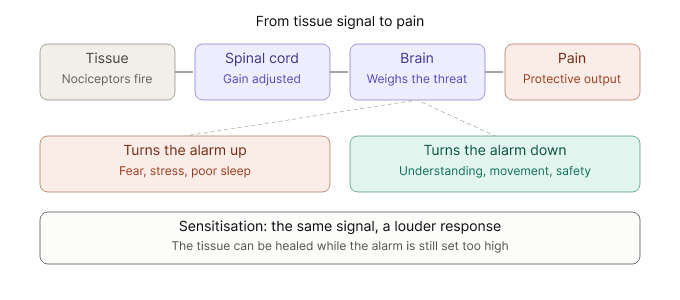
Your tissues send danger signals to your spinal cord and brain. Those signals are not pain. Your brain looks at them, checks them against everything else it knows (past injuries, stress, sleep, what you've been told, what you're worried about), and decides whether to produce pain. [Certain]
So pain is the brain's protective conclusion. It's closer to a car alarm than a measuring tape. A good alarm goes off when someone breaks in. An oversensitive one goes off when a leaf lands on the bonnet.
Patient: "So the alarm can be loud even when there's barely a burglar."
Freddie: "Yes, and the reverse is also true. Some people have big structural changes and almost no pain."
Your tissue and your pain run on different clocks
Tissues heal at set speeds, mostly depending on blood supply. These are rough windows under good conditions:
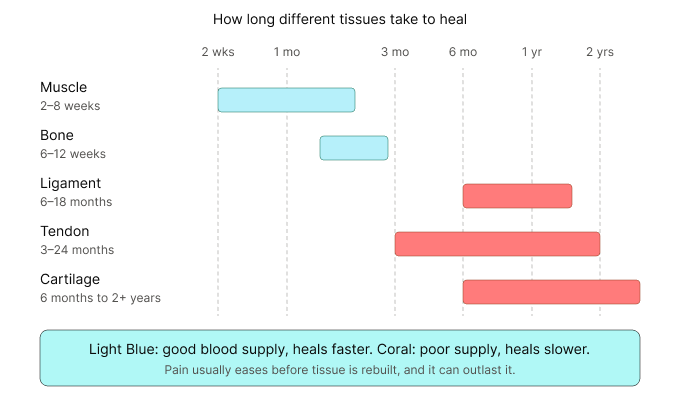
Two things worth knowing:
Pain usually eases before the tissue is fully rebuilt. Feeling better doesn't mean you're finished, which is why gradually loading the area still matters.
Pain can also hang around after the tissue has healed. Once it passes about three months, the useful question stops being "what's damaged?" and becomes "why is the alarm still on?" (Treede et al., 2015).
When the alarm stays on
This is called sensitisation, and it happens at two levels.
In the tissue (peripheral): after an injury, inflammation makes nearby nerve endings touchier. That's useful early on because it makes you protect the area, and it usually settles as the injury heals.
In the spinal cord and brain (central): if danger signals keep coming, or your system stays on high alert, the nerves in the spinal cord become more responsive. Pain can then linger, spread, or show up with movements that shouldn't hurt (Woolf, 2011).
That's the answer for anyone whose scan is clear and whose pain isn't. Nothing's wrong with your imagination. The ligament may be fully repaired while the nervous system is still guarding it.
Why timing matters, and what the evidence really says
The popular version is "see someone early or it becomes chronic." The evidence supports something narrower and more useful.
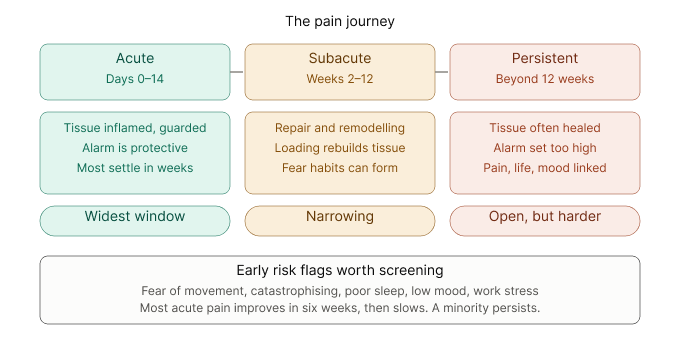
Most episodes of low back pain improve quickly in the first six weeks, then progress slows. A fair number of people still have symptoms a year later (Pengel et al., 2003; Costa et al., 2012).
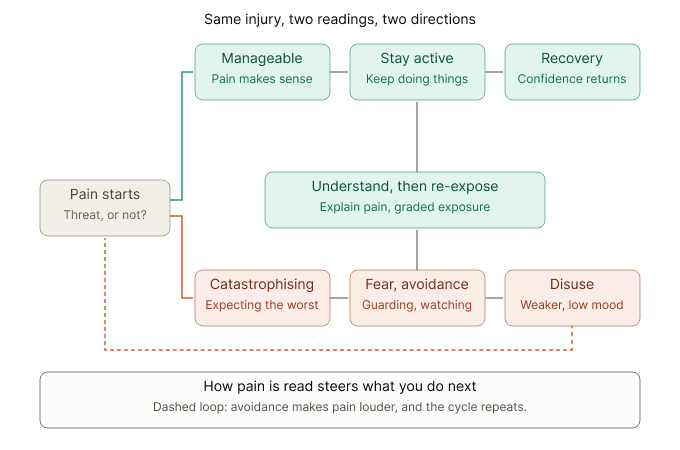
The people who don't recover are mostly predicted by what's going on around the tissue, not in it: fear of moving, expecting the worst, poor sleep, low mood, work or money stress.
Screening for those factors early, and matching the level of care to the person's risk, improved outcomes and cost in the STarT Back trial (Hill et al., 2011). [specific to back pain]
What the evidence doesn't show is that treating the tissue within a certain number of days prevents chronic pain. Hands-on treatment alone hasn't been shown to do that, and over-explaining scan findings in scary structural terms can make people more cautious about moving.
So early care matters because it's the chance to check for red flags, spot the risk factors, and keep you moving while the path can still be steered. The window never fully closes. It just gets harder to change as habits and sensitivity build.
What good early care looks like
Rule out the serious things first.
Explain what's happening in plain language, because understanding pain is itself part of treatment.
Ask about sleep, stress, work, and mood, not just where it hurts.
Keep you moving at a dose you can handle.
Use hands-on treatment to quiet the alarm so movement gets easier, then let the rehab do the lasting work.
Check against the expected timeline. If a muscle strain isn't clearly improving by about six weeks, that's the cue to look harder.
If you're already months in, the same ideas apply, with more emphasis on pain education, graded exposure, and sometimes approaches like OsteoMAP. Persistent pain is treatable, and it isn't anyone's fault.
Patient: "So when should I actually get something looked at?"
Freddie: "When it isn't following the timeline you'd expect for that tissue. A muscle strain that's not clearly improving by about six weeks is a good example. You don't need to wait for it to get worse."
Patient: "And what happens when I do?"
Freddie: "We rule out anything serious, work out which clock is running slow (the tissue or the alarm), and get you moving in a way that tells your nervous system it's safe."
Patient: "And if it's already been months?"
Freddie: "Same approach, with more emphasis on pain education and graded exposure. Persistent pain is treatable, and it isn't anyone's fault."
If something hasn't healed the way you expected, book an assessment at the-movement-co.com. The initial consult is 45 min at $115 NZD, and ACC subsidies are available for eligible injuries.
References:
Raja SN et al. (2020). The revised IASP definition of pain. Pain.
Moseley GL & Butler DS (2015). Explain Pain Supercharged.
Woolf CJ (2011). Central sensitization: implications for the diagnosis and treatment of pain. Pain.
Treede RD et al. (2015). A classification of chronic pain for ICD-11. Pain.
Pengel LHM et al. (2003). Acute low back pain: systematic review of its prognosis. BMJ.
Costa LCM et al. (2012). The prognosis of acute and persistent low-back pain: a meta-analysis.
CMAJ. Hill JC et al. (2011). Comparison of stratified primary care management for low back pain with current best practice (STarT Back). Lancet.
