How Strong Are You Really?
At-Home Tests for Muscle Strength and Power
"Freddie, I don't go to the gym. I don't lift weights. But I can carry my groceries and open jars without struggling. Does that count as strong?"
Freddie: "It counts. But it's not quite a benchmark. The interesting question is how you compare to what the research says keeps people healthy, functional, and independent — and whether you have a baseline to track over time."
Strength is not just for athletes
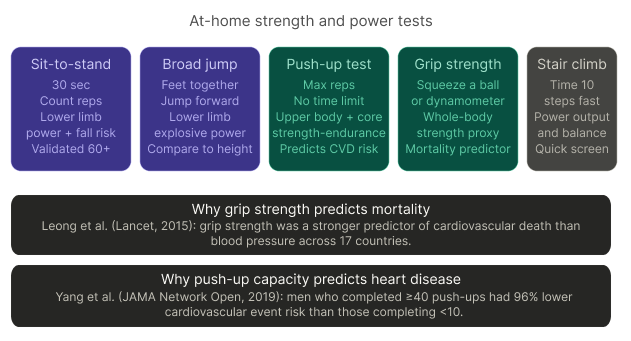
Muscle strength is one of the most powerful predictors of health outcomes we have. The PURE study — a landmark international cohort published in The Lancet (Leong et al., 2015) — followed nearly 140,000 people across 17 countries and found that grip strength was a stronger predictor of cardiovascular mortality than systolic blood pressure. Not a supplement. Not a medication. Grip strength.
Separately, a 2019 study by Yang et al. in JAMA Network Open found that men who could complete 40 or more push-ups had a 96% lower risk of a cardiovascular event over 10 years than those who could manage fewer than 10. Push-ups. Free. At home.
Strength is health. Here is how to measure it.
-
How to do it: Sit in a standard chair (height approximately 43cm), arms crossed over your chest. On "go," rise to full standing and sit back down as many times as possible in exactly 30 seconds. Count only complete stands.
The norms are in the table above. This test was developed and validated by Rikli and Jones (2001) specifically for older adults and has been widely adopted in clinical settings as a fall risk and lower limb power screen.
What it tells you: lower limb strength and power, fall risk, functional independence. Below-average scores are associated with significantly increased fall risk and earlier functional decline.
-
How to do it: Stand with feet shoulder-width apart, toes behind a line. Swing your arms back, then forward as you jump as far as possible, landing on both feet. Measure from the line to the back of your heels. Take the best of three attempts.
What to aim for: as a very rough guide, a healthy adult should be able to jump a distance close to their own height. Declining broad jump performance is associated with reduced lower-limb explosive power (fast-twitch muscle function), which is the first quality to deteriorate with age and inactivity.
Reference: Broad jump norms — NSCA Essentials of Strength Training and Conditioning.
-
How to do it: Standard push-up form — hands shoulder-width apart, body straight from head to heels, chest touching or approaching the floor. No time limit. Count until you cannot maintain form. (Modified on knees is valid — just note which you used.)
The norms are in the table above. Yang et al. (JAMA Network Open, 2019) found that push-up capacity was an independent predictor of cardiovascular disease risk in middle-aged men. Beyond cardiovascular risk, push-up performance reflects upper body strength, core stability, and functional pushing capacity — all of which decline with age and disuse.
-
Without a hand dynamometer (which is the clinical gold standard), you can get a useful proxy:
Forearm squeeze method: Hold a rolled towel or tennis ball and squeeze as hard as possible. While this won't give you a number in kilograms, doing this bilaterally and comparing your weaker to your stronger side gives you an asymmetry ratio. More than 15–20% difference between dominant and non-dominant hand can indicate unilateral weakness worth investigating.
For those with access to a dynamometer (increasingly available in gyms and physiotherapy clinics), norms from Mathiowetz et al. (1985, updated by multiple studies) show:
Men aged 20–40: dominant hand 46–56 kg, non-dominant 40–50 kg
Women aged 20–40: dominant hand 26–33 kg, non-dominant 23–30 kg
-
Time how long it takes you to walk up 10 consecutive stairs at your natural brisk pace. This requires no equipment and takes less than 30 seconds.
Research from Peteiro et al. (European Heart Journal, 2020) found that taking more than 14 seconds to climb 4 flights of stairs (approximately 60 steps) is associated with increased cardiovascular risk. Scaling for 10 steps, a brisk time under 5–6 seconds is a reasonable functional target. Beyond cardiovascular associations, slow stair performance reflects integrated lower limb power, balance, and coordination.
What to do with your results
These tests give you a snapshot. More importantly, they give you a baseline.
Track them every 3 months. Improvement is meaningful — and achievable at any age with the right training.
At The Movement Co, we use objective strength testing (VALD Dynamo and Force Decks) to give you actual numbers.
But these at-home tests tell you a great deal and cost nothing but time.
References:
Leong DP et al., Lancet 2015;
Yang J et al., JAMA Network Open 2019;
Rikli RE & Jones CJ, Human Kinetics 2001;
Peteiro J et al., Eur Heart J 2020;
Mathiowetz V et al., 1985;
NSCA CSCS 4th Ed.
