Pain is personal.
Here's why.
"Freddie, I've noticed that two people can have the exact same injury and one is back at the gym in three weeks and the other is still suffering six months later. What is going on there?"
Freddie: "That right there is the most important question in pain science. And the answer has nothing to do with one person being tougher than the other."
Same injury. Different experience. Why?
Because pain isn't just about the body. Pain is about the person.
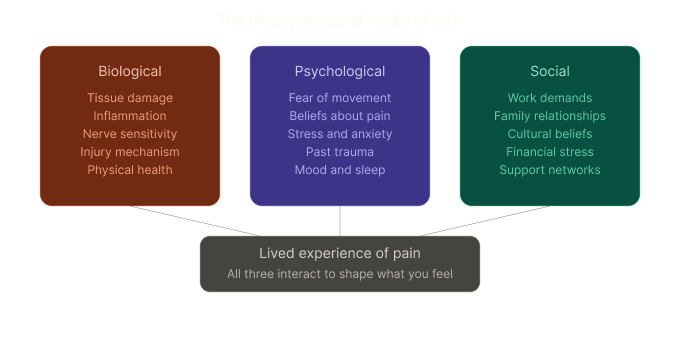
This is the foundation of the biopsychosocial model — a way of understanding health and injury that looks at three overlapping worlds:
Biological — the actual tissue, the nerve, the inflammation, the injury mechanism
Psychological — your thoughts, fears, beliefs, stress levels, sleep, past experiences
Social — your job, your relationships, your culture, your financial pressures, your support network
All three feed into each other. All three shape the pain you feel. This isn't theory — it's supported by decades of research and is now the gold-standard framework in pain medicine, rehabilitation, and musculoskeletal care.
The lived experience — your story matters
Here's something we ask every person who walks through the door at The Movement Co: tell me about your pain.
Not just when it started. Not just where it hurts. The full picture:
What were you doing when it happened?
What do you think is wrong?
What does this injury stop you from doing?
How's work going? How's sleep? How's life?
That last question sometimes surprises people. But here's why it matters.
Two patients, same MRI result — a disc bulge at L4/L5. Patient A is a nurse on her feet all day, going through a separation, barely sleeping, terrified she'll never run again. Patient B is a retired teacher with a supportive family, low stress, who's been told by a trusted friend that "backs get better." Same scan. Wildly different pain experiences. Wildly different outcomes.
The tissue is one input. The person is everything else.
This is what we mean by lived experience — and it's the part most clinics miss.
Now, here's how those three worlds actually talk to each other in the real world.
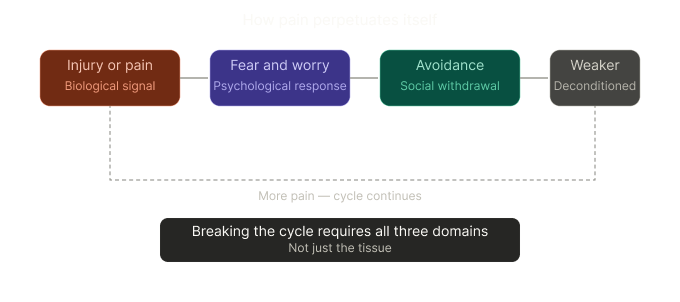
This is why chronic pain is so difficult to crack with tissue treatment alone. You can mobilise a joint perfectly and the person still doesn't move freely — because their nervous system has learned that movement equals danger. The fear is real. The avoidance makes biological sense. And the deconditioning that follows makes the whole thing worse.
The cycle feeds itself. Until something interrupts it.
What The Movement Co does about it
"So where do you come in? You can't fix someone's difficult divorce or their fear of re-injury just by working on their back."
Freddie: "You're right. We can't. But we can create a window."
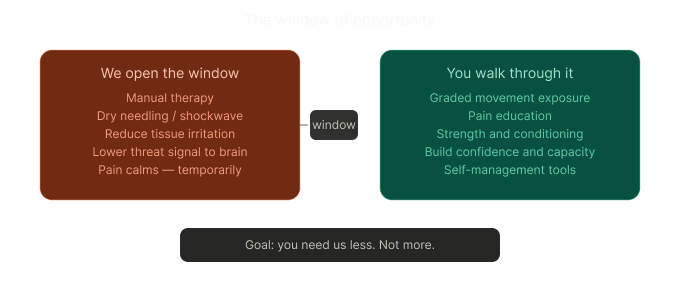
This is exactly how we think about our work. We work on the biological — the tissue, the movement, the load — to create a window of opportunity for the person to take back control.
Here's what that looks like in practice:
1. Reduce the biological noise first
Manual therapy (soft tissue work, joint mobilisation, dry needling) calms the irritated tissue
This lowers the threat signal being sent to the brain
Pain decreases — even temporarily — and that opens a door
2. Reintroduce movement with confidence
Graded exposure: carefully dosed movement that shows the nervous system "this is safe"
Each successful rep is data the brain uses to update its threat map
Over time, the brain stops treating movement as danger
3. Explain what's actually happening
We spend real time in sessions talking through the biopsychosocial picture
Research shows that understanding pain science reduces pain intensity and improves outcomes
Knowing your pain is not purely structural — that it's also driven by sensitivity and context — is genuinely therapeutic
4. Build physical capacity
Stronger muscles, better load tolerance, improved movement quality
The body becomes more robust — so the biological trigger gets harder to set off
This is the rehab phase most clinics skip
5. Hand back control
The goal is always self-management
Home exercise, load management, lifestyle tools
You leave us with a plan, not a dependency
The window we create with hands-on treatment is only useful if you walk through it. Our job is to open the door. Your job — with our support — is to step through.
The bottom line
Pain is not a simple read-out of how damaged you are. It's the product of your biology, your psychology, and your social world — all talking to each other, all the time.
Your lived experience matters. Your story matters. The scan doesn't tell us nearly as much as you do.
At The Movement Co, we treat the tissue because that's where we can have the most immediate impact. But the real goal is always bigger than that — to help you understand your pain, trust your body again, and move through life without needing a clinician to keep you going.
"I came here thinking we were talking about backs and necks. Turns out we're talking about the whole human experience."
Freddie: "We always were."
