Why Does This Take So Long?
Healing Times and What Affects Them
"Freddie, why did my mate sprain his ankle and be back running in three weeks, but I tore my ACL and I was out for a year? Same region, completely different story."
Freddie: "Because not all tissue is created equal. Your ankle — probably muscle and mild ligament.
Your ACL — ligament with very poor blood supply. The body doesn't have a flat healing rate. It depends entirely on what got hurt."
Why blood supply is everything
The rule of thumb in healing is simple: the better the blood supply to a tissue, the faster it heals.
Blood brings oxygen, nutrients, immune cells, and the building blocks for repair. Cut that off, and healing crawls.
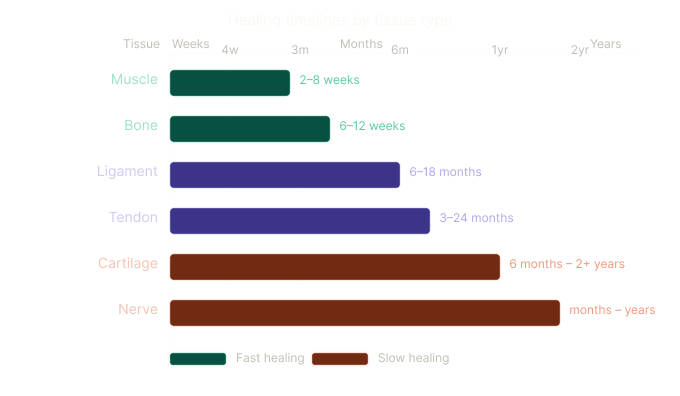
This is why muscle heals in weeks — it's highly vascularised. It's also why cartilage is the frustrating exception to almost everything — it has essentially no blood supply at all. It relies on diffusion through joint fluid, which is slow and limited.
Tendons and ligaments sit somewhere in the middle. They have some vascularity, mostly at the ends where they attach to bone — which is why mid-tendon tears (like an Achilles rupture) are so much slower than a muscle belly tear.
Nerves are their own category entirely. They can regenerate, but only at roughly 1mm per day along the nerve path. A nerve injury close to the target muscle? Months. A nerve injury high up the limb? Potentially years before function returns.
The chart above gives a rough guide. Keep in mind these are ranges under good conditions — optimal loading, nutrition, sleep, stress management. In practice, most people sit toward the slower end of these windows.
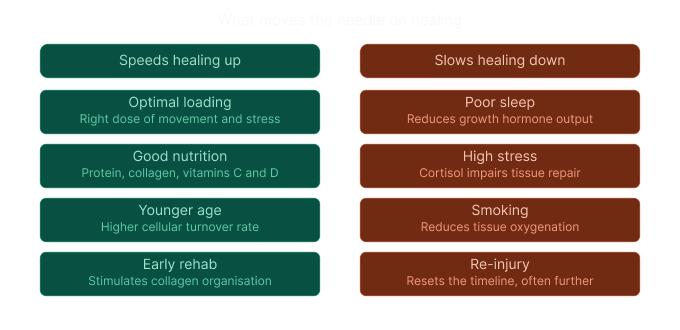
Now, the tissue type sets the ceiling. But a whole range of factors determine where in that range you actually land.
The most common mistake: too much or too little
The biggest variable you control is load — how much you use the injured tissue during recovery.
Too little: the tissue heals weak and disorganised. Collagen fibres lay down randomly without the mechanical signal that tells them which direction to align. The result is scar tissue that tears again easily.
Too much: you outpace the repair process, creating micro-damage faster than the tissue can rebuild. This is the classic overtraining injury — the person who "pushes through" and wonders why they're not getting better.
The goal is the window between those two — a concept we call optimal load. At The Movement Co, we use this as the guiding principle for every stage of your rehab. We test where you are, we prescribe accordingly, and we adjust at every session.
The honest answer on timelines
When someone asks "how long will this take?", the truthful answer is always a range, not a date.
The tissue type sets the floor. Your sleep, nutrition, stress, age, and rehab compliance determine where in that range you land.
What we can promise is this: with the right approach, you'll be at the faster end of that window — not the slower one.
"So you're saying the tissue heals on its own schedule, but you can influence the environment it heals in."
Freddie: "That's exactly it. We can't speed up biology — but we can give it the best possible conditions to do its job."
