Moving Well, Living Well
"Freddie, my grandmother keeps telling me she's 'just getting old' every time she mentions her sore knees, her dodgy balance, or the fact that she's shrinking. Is she right? Is it just age?"
Freddie: "Some of it is age, yes. But a lot of what people chalk up to 'just getting old' is actually modifiable. The body responds to training at any age. The question is whether anyone is paying attention to the right things — early enough."
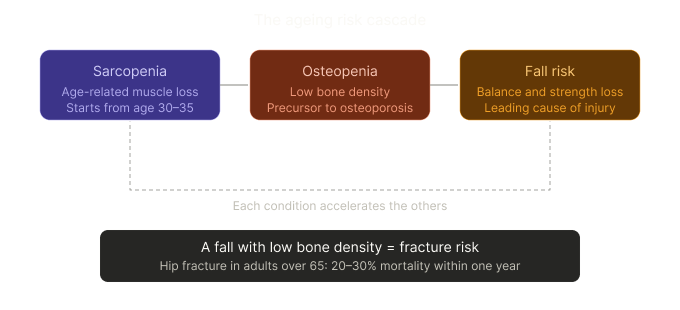
The three things that quietly derail senior health
Ageing brings a predictable set of changes that, if left unaddressed, compound on each other. The diagram above shows the three big ones.
Sarcopenia — the gradual loss of muscle mass and strength — begins earlier than most people realise, around age 30–35, and accelerates after 60 if nothing is done about it.
Osteopenia — reduced bone mineral density — follows a similar trajectory, particularly in post-menopausal women. And as muscle and bone quality decline together, fall risk rises.
Here's the brutal statistic: a hip fracture in an adult over 65 carries a 20–30% mortality rate within one year.
Not from the fracture itself — from the cascade of complications, hospitalisation, deconditioning, and loss of independence that follows.
The good news is that all three of these conditions respond meaningfully to the right intervention — at any age. You do not have to accept the trajectory.
Why we screen — and what we use to do it
Most people don't know their fall risk. They don't know their functional strength.
They don't know whether the way they move is quietly setting them up for an injury.
At The Movement Co, we change that with a structured, technology-led functional screening using two gold-standard tools: the VALD Dynamo and the VALD Force Decks.
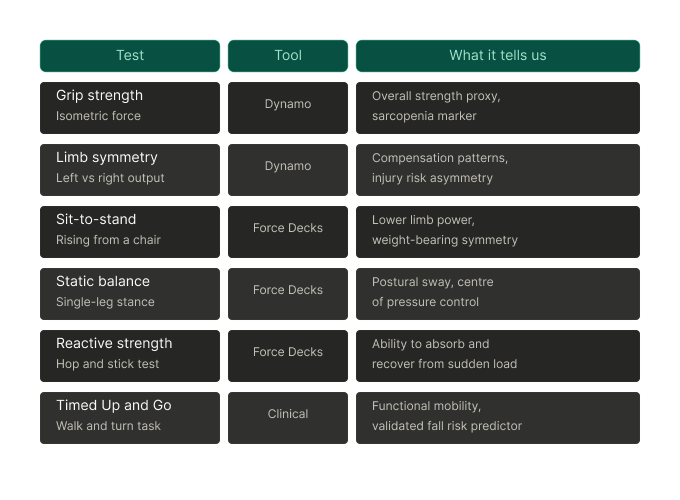
The VALD Dynamo is a handheld dynamometer — it measures muscular force output precisely, joint by joint. We use it to assess grip strength (a validated predictor of overall health and longevity), limb-specific strength deficits, and asymmetries between sides. Everything is captured numerically and benchmarked against age and sex-matched norms.
The VALD Force Decks are dual force plates that measure how you distribute load between your left and right sides during standing, sitting, rising, and jumping tasks. They capture balance, weight-bearing symmetry, reactive strength, and rate of force development — in real time, with data you can see.
The result is a full written report — not a generic printout, but a personalised clinical summary of your movement health, your risk profile, and a clear starting point for intervention.
Here's a summary of what the screening covers and what each test tells us:
Bone density and sarcopenia — what we assess and when to refer
Bone density is measured formally by a DEXA scan, which requires a GP referral.
At The Movement Co, we don't perform DEXA scans — but we do identify who should be asking their GP for one.
During your intake assessment, we screen for key risk factors:
For osteopenia and osteoporosis risk:
Post-menopausal women — bone loss accelerates significantly after menopause
Men over 70
History of low-trauma fractures (breaking a bone from a minor trip or fall)
Long-term corticosteroid use
Low body weight or BMI under 18.5
Family history of hip fracture
Smoking or high alcohol intake
For sarcopenia:
The VALD Dynamo gives us objective grip and limb strength data to benchmark against validated norms
We also assess gait speed, sit-to-stand performance, and muscle function under load
The EWGSOP2 (European Working Group on Sarcopenia) criteria use a combination of strength testing and physical performance — and our screening covers all of these components
If screening suggests significant bone density risk, we flag it clearly in your report and recommend GP review. These conversations are better had early. A fracture is a much harder conversation.
What osteopathy at The Movement Co can do for older adults
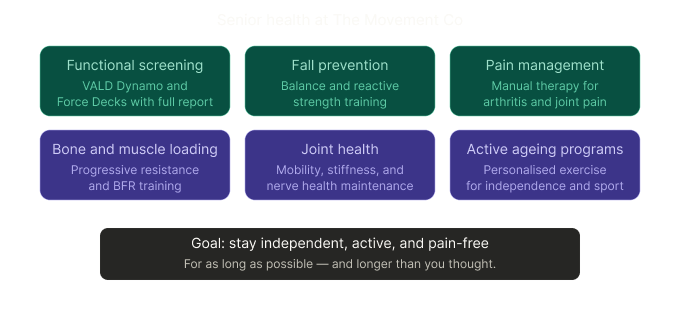
Here's where we bring it all together. Osteopathic care for senior health isn't about cracking backs — it's about keeping the whole system moving well, reducing pain, and building the physical resilience to stay independent and active.
Here's what we offer this population specifically:
Pain management and joint health
Arthritis — both osteoarthritis and rheumatoid — is one of the most common reasons older adults lose mobility and confidence.
Manual therapy can meaningfully reduce joint pain, improve range of motion, and restore the movement patterns that pain has disrupted.
We don't chase a cure for structural change — but we can substantially improve how a degenerative joint functions day to day.
Spinal stenosis, disc degeneration, peripheral neuropathy — these too respond well to a combined approach of targeted manual therapy and functional loading.
Progressive resistance and bone loading
This is one of the most underutilised interventions in senior health. Bone is living tissue — it responds to load by becoming denser.
Resistance training is one of the few interventions proven to slow, and in some cases partially reverse, bone density loss.
We use Blood Flow Restriction (BFR) training for seniors who can't tolerate high external loads — it produces significant strength and muscle gains at a fraction of the joint stress. This makes it ideal for frail or deconditioned older adults, post-surgical patients, or anyone with significant arthritis. Though this can only be used when there is no pre-existing cardiovascular risk from our screening.
Balance and reactive strength
Falls don't happen slowly. They happen in a split second — a stumble on a kerb, an uneven surface, a moment of distraction.
The question is whether your nervous system can react fast enough to save you. This is reactive strength — and it's trainable.
Our Force Deck testing shows us exactly where your reactive capacity sits. From there, we build a program that specifically trains the fast-twitch response needed to catch a trip before it becomes a fall.
Active ageing — beyond just "not falling"
Senior health at The Movement Co isn't just about risk reduction. It's about continuing to do the things that matter — walking the Ōtago Peninsula, playing golf, chasing grandchildren, getting on a plane, picking up a pack. We had clients in their 60s and 70s completing their first strength programmes, returning to tramping, and moving better at 75 than they did at 65.
"So you're saying age is not a ceiling."
Freddie: "For movement? No. It's not. The ceiling is much higher than most people have been told."
Where to start
If you're over 50 — or if you have a parent or grandparent who's had a fall, is losing strength, or is quietly slowing down — a functional screening assessment is the right first step.
You'll leave with a clear picture of where you stand, what the risks are, and a personalised plan to address them.
Not generic advice. Actual data, and an actual plan.
