What is osteopathy?
“Freddie, I've been hearing this word — osteopathy — and I genuinely don't know if it's a kind of pasta or a type of doctor. Can you help me out?"
Freddie: “I love it. Okay, so it's definitely not a pasta — although if your back is so stiff you can't reach the pot, we can help with that too."
Welcome to the very first blog post from The Movement Co. We're going to break down what osteopathy actually is, why it exists, what we do here in Ōtautahi, and why we think the old way of doing things needed a serious upgrade. No jargon, no boring textbooks. Just a real conversation.
So... what even is osteopathy?
Osteopathy is a form of manual healthcare — meaning we use our hands — focused on diagnosing, treating, and preventing a wide range of physical problems. Think back pain, neck pain, joint issues, sports injuries, headaches, and even fatigue-related problems that creep up after years of sitting at a desk, or drilling away with a power tool.
It was founded in the 1870s by an American doctor named Andrew Taylor Still, who had a pretty radical idea for the time: the body is one interconnected system, and if you treat it as a whole rather than a collection of separate parts, it heals better. For the 1870s, that was basically saying the earth was round. People were not ready, and to be honest, not many people are ready for it even in 2026.
But it stuck — and today osteopathy is a regulated, evidence-informed healthcare profession practised across the world. Here in Aotearoa, all practising osteopaths must be registered with the Osteopathic Council of New Zealand (OCNZ). I (Freddie)— the founder of The Movement Co — am a Master of Osteopathy graduate from the Health Science University (UCO School of Osteopathy) in the UK, formerly known as the British School of Osteopathy, one of the most respected osteopathic institutions in the world.
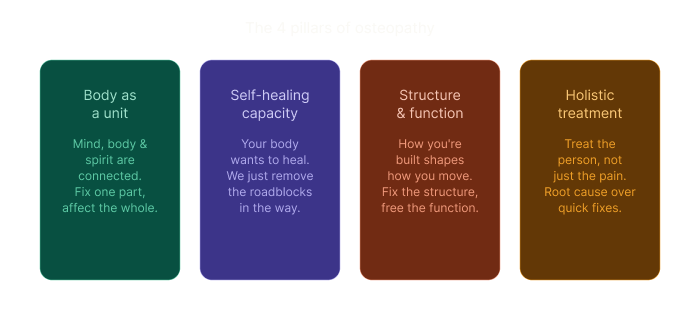
The 4 Pillars of Osteopathy
the WHAKAARO behind the practice
Every osteopath — no matter where they trained — works from these four core ideas:
The body is a unit. Your spine, your gut, your mood, your sleep — they're all talking to each other. We don't zoom in on just your sore knee. We look at the full picture.
The body has its own self-healing capacity. This one always gets people. You already have the tools to heal. What we do is remove the obstacles — whether that's restricted movement, poor mechanics, or overloaded tissue — so your body can do its job.
Structure and function are related. How you're built affects how you move. How you move affects how you feel. This is why your "desk posture" might actually be causing your headaches.
Treatment is holistic. We treat the person, not just the symptom. That means looking at your lifestyle, your movement habits, your load — not just where it hurts.
These four ideas have been the backbone of osteopathy for over 150 years. They're still right. But the way we apply them? That's where things at The Movement Co get exciting.
So what do you actually DO in a session?
"Right, because I imagined it was someone cracking your back and telling you to drink more water."
Freddie: "Ha! There's a little more to it than that..."
Here's an honest breakdown of what a session at The Movement Co looks like:
Gold-standard orthopaedic testing. Before we touch anything, we figure out what's actually going on.
We use the same clinical tests used in sports medicine and orthopaedics to build a working diagnosis — not just a guess.Manual therapy. This is the hands-on part. Soft tissue work, joint mobilisations, dry needling, shockwave therapy, cupping, tissue flossing — we have a toolkit, and we use what the evidence says works best for your specific issue.
Strength and conditioning rehabilitation. This is the part most clinics skip. Pain relief is only half the job. If we don't rebuild the strength, stability, and resilience around the injured area, you're coming back in six months with the same problem. We use tools like Blood Flow Restriction (BFR) training, dynamometer strength analysis, and neuromuscular electrical stimulation (NMES) to accelerate your recovery.
Progress tracking. Every session, we reassess. Are you actually getting better? By how much? What do we need to adjust? This isn't vague — it's data-driven.
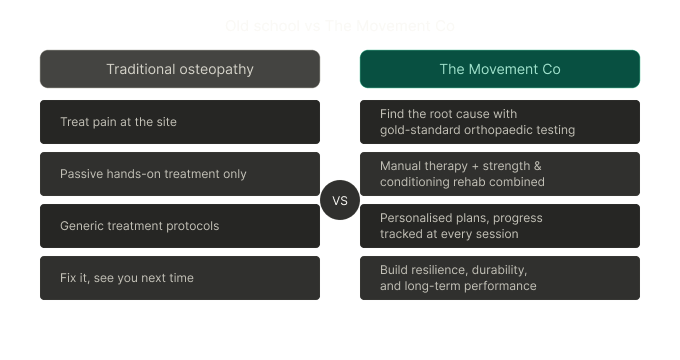
Same roots. But much better outcomes
The new kid on the bloc.
Look — traditional osteopathy is great. The philosophy is sound and the hands-on skills are genuinely effective. But a lot of clinics still operate the same way they did 30 years ago: you come in with pain, they treat the pain, you feel better temporarily, and then you're back again. It's a cycle.
At The Movement Co, we believe that's not good enough. We want to know why you're in pain. We want to fix the source, not just the signal. And then we want to make you stronger and more resilient than you were before you walked in — so you don't need us as often.
"So you're essentially trying to make yourself unnecessary."
Freddie: "Exactly. It’s like you hire a carpenter to build a functioning kitchen that last your house and never to have them back again.
The best outcome is that you leave us able to manage yourself. That's the goal."
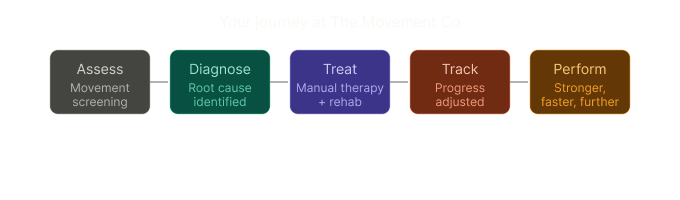
Trust the process. Trust the flow.
Your journey with us — step by step
It's five steps: assess → diagnose → treat → track → perform. Simple in structure, deeply personalised in practice. Every step feeds into the next. We don't skip ahead. We don't guess. We follow the process.
Who do we work with?
Honestly? Everyone. From the office worker with a chronic sore neck to the trail runner prepping for a mountain race to the competitive rock climber trying to recover from a finger injury. We also offer specialised Mountain Athlete Training programmes for alpine sports — trail running, sky running, sport climbing, bouldering, alpinism. Freddie is a BMC-qualified climbing coach and an international routesetter, which means this isn't just general fitness programming — it's discipline-specific, terrain-specific training built on real experience in the mountains.
We're also ACC-registered, so eligible injuries may be subsidised. Lower cost, same level of care.
The bottom line
Osteopathy at its core is a beautifully logical idea: the body is connected, it wants to heal, and if you understand how structure shapes movement, you can fix almost anything.
What we've done at The Movement Co is take that philosophy — those 150-year-old tenets that are still completely valid — and layer on top of them the best of modern sports science, evidence-based rehabilitation, and advanced technology.
It's not osteopathy or modern medicine. It's both. It's the art and the science, working together.
Ready to move better, stronger, and faster? Book your initial appointment at the-movement-co.com — or reach out if you're not sure whether we can help. We love a good challenge.
